
Saturday, April 26, 2025


The Philadelphia Zoo: Water Is Life
Water Is Life is the latest new complex of habitats built at the Philadelphia Zoo, and it's a strange concept. Ostensibly home to Red Pandas and Giant River Otters, there is also a third habitat which last visit had a pair of Hamerkops, and this time a little colony of Vampire Bats! It's more suited to the bats. But when you think about it, Water? A unifying factor? It's really odd; and, it's also lovely. Both of the main spaces give the animals who live there lots of options for spaces to hang out--together or apart. This is no mean thing for the Giant River Otters.
Native to South America and calling rivers like the Amazon home, they are, indeed large! Twice the size easily of the more familiar North American River Otters, but still obviously taxonomic "cousins". Besides their size, Giant River Otters also have distinctive beige/white markings on the undersides of their jaws and necks. It appears that they're down to 3 otters now. When they first opened up the habitat to the public, they had two pairs. It's the only time I've ever witnessed otters mating... Fascinating, serious business.


Red Panda
Ailurus fulgens
I have some amazing photo of Red Panda from previous visits to the Philadelphia Zoo. But not this time! It's all part of the crap shoot that visiting a zoo can be. It's not my home. I'm just a visitor--an idea that has never been more clarion to me than this past week.

Giant River Otter
Pteronura brasiliensis


Philadelphia Zoo: The South End
The Philadelphia Zoo, as America's First Public Zoological Park, has a very interesting history. It was founded on an estate that was founded by John Penn, a grandson of William Penn the founder of the colony of Penn's woods, a.k.a. Pennsylvania. The estate was called the Solitude for its location outside of the city proper along the banks of the Schuylkill River.

Now, this might give you the impression that the Philadelphia Zoo is small. That is not true. 42 acres well designed can feel like so much more.
On my first visit so long ago it was before GPS on smart phones. When my friends and I arrived we weren't sure who to get in, where to park, etc. None of us had been there before. It was a summer Saturday and the place was packed, even by 10 AM! We eventually found a place on a service road that runs around the west side of the zoo next to the railroad. We entered through the south entrance, now closed to the public. The first thing I saw was a Camel ride (no longer part of any accredited zoo) and a Red Panda in a wood frame habitat that was more like a cage than a place to thrive. The place has come SO FAR in the past 20 years!


New walkway at the new large bird habitat.


Crested Caracara
Caracara cheriway

Habitat formerly used by Maned Wolves, now identified as a Ground Hornbill home.

Large Cheetah Habitat.


Cheetah
Acinonyx jubatus


Friday, April 25, 2025
Philadelphia Zoo: Big Cat Falls
Philadelphia joins a host of amazing Zoos that combine most of their Big Cats in a single complex, like the Memphis Zoo, the St. Louis Zoo and the Little Rock Zoo. Big Cat Falls first opened to the public in 2006, and was overhauled and updated in 2025. I was very much impressed by all of the upgrades, and got to experience a wide range of the zoos' large feline species.

The benefits of the upgrades, while cosmetic in some ways, were apparent from the moment I entered. They gave a fresh clean feel to everything and honestly left me wondering at moments if I'd even ever seen certain aspects of the complex before in previous visits.

The combined entrance/exit to the collection of Big Cat Habitats.

African Lion
Panthera leo


The Puma Habitat.

Puma
Puma concolor

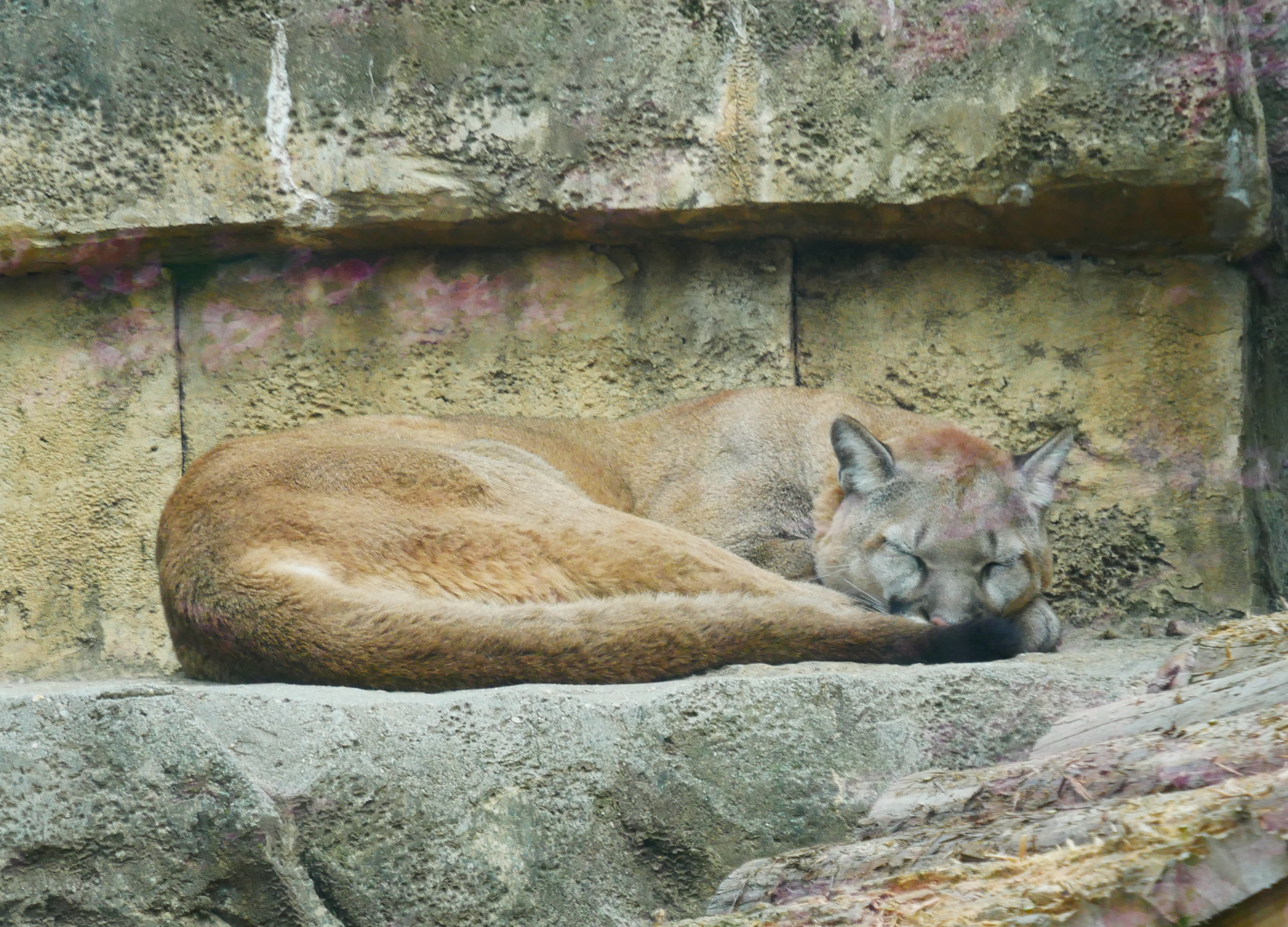

The Snow Leopard Habitat.

Snow Leopard
Panthera uncia

The way to the Amur Leopard Habitat.

Amur Leopard
Panthera pardus orientalis

Amur Tiger Habitat


Amur Tiger
Panthera tigris altaica


Dimitri came right up to the glass for an amazing close-up.
Wednesday, April 23, 2025
Philadelphia Zoo: Primate House


The Philadelphia Zoo's PECO Primate Reserve has also had a bit of a baby boom with successful live births of an Orangutan, a White-Handed Gibbon and a White and Black Colobus. Sumatran Orangutan births are always a source of great celebration as the species is on the fast track to extinction. I was very fortunate to have gotten to see Sugi (born last June) on his first day outside last August. On this trip, the Orangutans weren't early risers, and so I got to watch the keepers prep their interior day room and then a single male emerged to have breakfast. I assume it was Jambi, but I don't know them well enough to know for certain.
The associated exterior yard with its humongous Sycamores was occupied on this morning by the family of White-handed Gibbons. The species is gender dimorphic meaning that males and females are different colors. The females are a blond/beige while the males a deep dark brown/black. Newborns tend to be dark brown and then morph up or down in color as they reach the end of their first year of life. The Philadelphia Zoo is home to a very successful breeding pair: 35-year-old female Phoenice and 34-year-old male Mercury. The birth of Eros on March 14th of this year brings their family of offsprings up to 3! Eros has both an older brother (Polaris, born in 2018), and an older sister (Ophelia, born in 2023).
The Stork's other delivery was a baby White and Black Colobus monkey on January 27th of this year. The happy parents are both 11-years-old and first timers. The mother is Tatu, and the father is Dexter--who was born at the Maryland Zoo in 2014! It's so exciting to see these connections between my beloved Maryland Zoo and others. The baby, Yeti, is a male.
During my visit, I was also able to see the Coquerel's Sifaka and Ring-tailed Lemurs and the Western Lowland Gorillas.

The Ring-tailed Lemur "Island"--that is actually a peninsula. You can see the line of bubbles in the water? This is strategic. It fools the Lemurs into thinking that a predator is lurking beneath them, and they never try to get in the water or jump away.

Ring-Tailed Lemur
Lemur catta


Tatu and Yeti awaiting the opening of the Habitat-Trail.

White and Black Colobus Guereza
Colobus guereza

A male enjoying the Habitat-trail over the Giant Tortoise yard.


Coquerel's Sifaka
Propithecus


Western Lowland Gorilla
Gorilla gorilla

White-Handed Gibbon
Hylobates lar


Sumatran Orangutan
Pongo abelii


Subscribe to:
Posts (Atom)