Fourth of July week means it time for the annual Smithsonian Folklife Festival down on The National Mall. This is something I look forward to every year--even in recent years when the selection of focuses have been pretty lame at times. I still the miss the glory years when they would feature three things: A Country or National Region (Mali, Italy, Tibet), A state (Texas, Wisconsin, New Hampshire), and an agency of the Federal Government (National Parks Service, Library of Congress, NASA).

This year there was a sense of the good old days with one country and one cultural region. This year the festival celebrates Armenia and Catalonia. Let's start with Catalonia. The basic premise is that representatives of various aspects of the featured nation's culture set of booths where they demonstrate their skills and provide opportunities to interact with visitors. There are also regional food vendors and stages for performances, lectures, even cooking classes. The job of the visitor is to wander and watch and ask and eat and enjoy.

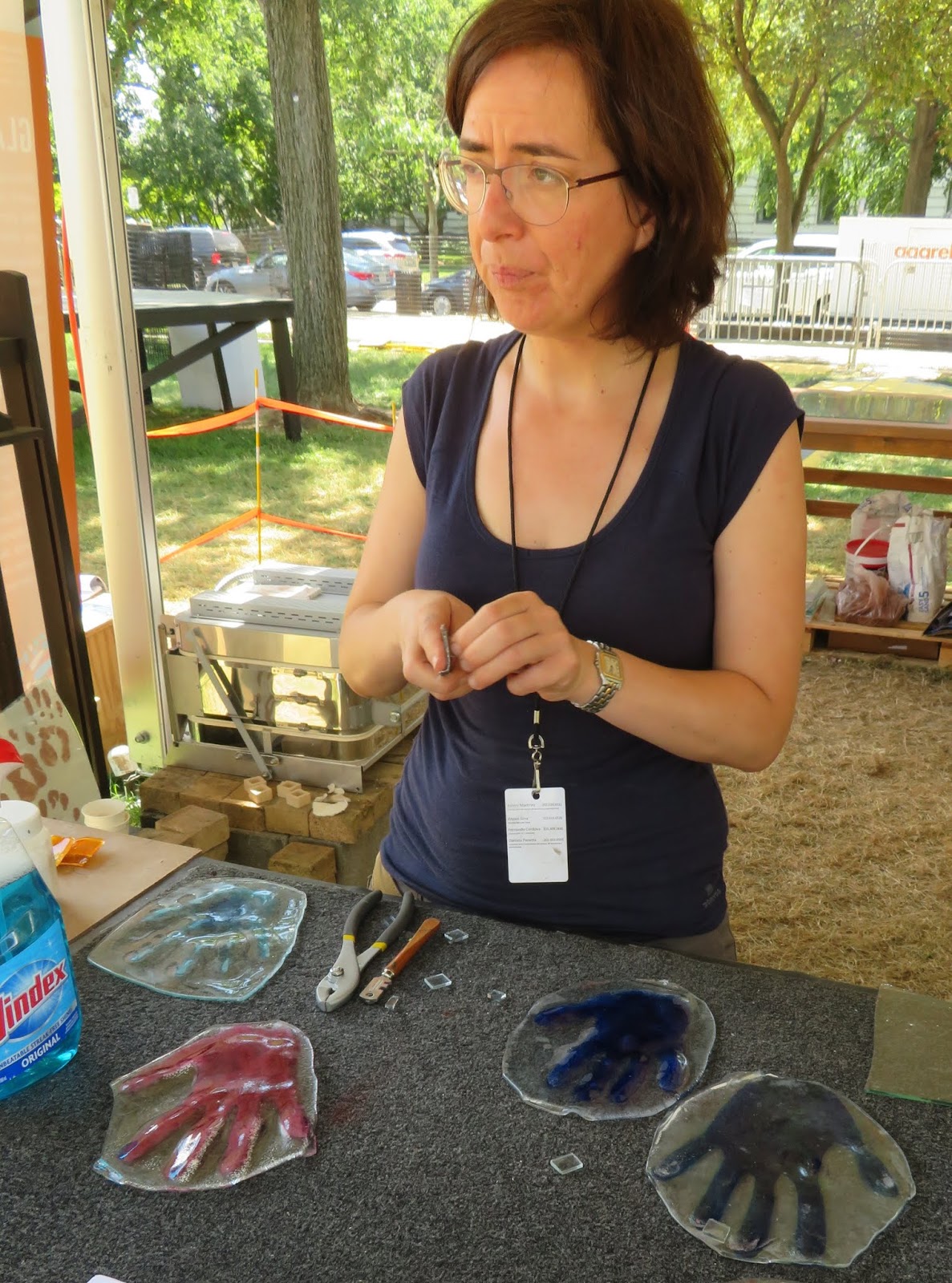
This woman works with the artist who makes these lovely glass bowls among other things. The techniques and resources he uses to achieve his final products are all rooted in the volcanic mountainous region of Catalonia where he grew up. She was working on a project that he was creating in honor of the festival that involved the glass impressions of visitors' hand prints.
Next to this was this master potter and his apprentice. The young man helped to interpret what he was doing and answer questions in English.
This woman was demonstrating traditional techniques in mosaic making: think the architect and Catalonian icon Antonio Gaudi.
This group represented a team of professional "human" tower builders. Apparently this is a really big deal thing with competitions and lots of team pride involved.
I will call this young man the captain and he took the lead on interpreting what they were doing and answering questions from the onlookers.
Then they made some smaller towers. At set times in the festival, all 350 members of the team would demonstrate much taller towers. Unfortunately they were performing on this day.
A poster depicted the real deal -- 9 levels high!
The next demonstration I stopped to watch was all about giant processional puppets complete with a craftsperson making them, costume-makers working on the elaborate clothing and dancers performing as they would for a religious or secular celebration.
They weight between 85 and 120 pounds each. And this cheeky fellow from the group was having some fun lifted this puppets skirt to the delight of the children in the crowd.
This craftsperson was building the frame for what would become a horse. The puppets take on non-human forms, too.
Placards like this one were certainly helpful in interpreting the events and providing more information.
Looking past puppets of a dragon and an otter into the tent were they were making and displaying some of the costumes used by the puppets.
This fellow was a stonemason and he was constructing a traditional field shanty. Once used by ancient farmers to get out of the sun and rain in when the weather turned or they were tired. They are made from the field stones gathered when the land was first being made arable and fit for planting.
The last area shared some aspect of the catalonian culture as it manifests along the Mediterranean Sea Coast.
 Across the grassy middle of The Mall is the other featured nation: Armenia. I remember a couple of years ago when the featured nation was Azerbaijan--Armenia's sworn enemy. And I recalled how delightful it was to learn about all the beautiful things from that country. Now many more beautiful things were laid out in front of me. I thought, 'What is there of man's conceptualization that keeps one people from living in peace with another? What keeps them from sharing the beauty they cherish without fear of the beauty the other brings to share? I know that in this case is it religion. Pathetic reason to hate one another. But let us not dwell on my tangent--there is much beauty to discover!


 A family of stone carvers were all busily chipping and gouging away at slabs of volcanic rock, sandstone and limestone to create these beautiful carvings, many used as architectural elements in homes and churches.