Showing posts with label Little Rock Zoo. Show all posts

Saturday, December 28, 2024

Little Rock Zoo: Great Primates

 We ended our visit to the Little Rock Zoo at the Great Apes Complex.  Given our experience in Memphis, we decided that later in the day was better.  And leaving the Bird House the rains had stopped again and the sky was lightening a little.  The complex is made up of 4 large habitats.  Two are designated for the Western Lowland Gorillas, and one each for Bornean Orangutans, and Chimpanzees.  The Little Rock Zoo is home to two Gorillas, four Orangutans and a troop of seven Chimpanzees.  Guests enter a pathway that leads to a central view plaza from which all four habitats can easily be seen.  Each is large and has water features appropriate to the species along with various climbing and perching apparatus, with the exception of the smaller of the two Gorilla habitats that looks a little forlorn.  The reason may be plans to introduce a fourth species, the Mandrill, at some point in the near future as outlined in the zoo's current Master Plan.

Not sure if anyone would be out, I made sure to get at least one photo of a gorilla.  A marvelous statue of one greets guests approaching the complex from the west.  The first habitat with possible inhabitants is the Orangutan yard.  The Zoo's Orangutans are a family unit with a male (Bandar), female (Benari) and two offspring, Kasih (a female, age 5), the youngest of which was born in February of this year, Kota (a male).  In spite of the inclement weather, Benari and Kota were outside hanging out on the dry surface near the entrances to the inner habitat.

Alas no chimps.  Though there door was open and you could hear their vocalizations.

In the second Western Lowland Gorilla habitat we encountered both.  Kivu is their male age 32, and Alice is their female.  Alice has a chronic skin condition that requires constant care which the Little Rock Zoo has undertaken and refined.  It is a great example of an individual animal who would not survive in the wild finding a quality life within the AZA zoo community.  

Viewing window for the lower yard.

View of lower yard

View of Orangutan Habitat

Can you see Berani?

Berani and Kota


The upper Viewing Plaza looking in the direction of the second Gorilla Habitat.

Interactive educational activity located in the middle of the plaza.

Western Lowland Gorillas, left to right; Alice and Kivu

Alice with her skin condition visible.

Alice foraging.

Mighty Kivu.


He is the first Silverback I've ever seen who is more Rufusback!

Looking toward the Chimpanzees Habitat

Chimpanzee Habitat.

Leaving the plaza, Gorillas on the left, Chimpanzees on the right.  

Friday, December 27, 2024

Little Rock Zoo: Aviary, Reptiles, and Small Primates House

 This section was more or less lifted from the Little Rock Zoo map again.  It's essentially a building where birds, monkeys and at one point reptiles lived.  But first a caveat.

The Little Rock Zoo is home to a trio of Asian Elephants.  All are along in years, and like the Smithsonian National Zoo in Washington, D.C., the Little Rock Zoo specializes in the geriatric care that female Elephants from 64 to 59 require.  While visiting the Sumatran Tigers earlier, we could see them in the Elephant yard and opted to get a closer look on our way back around; however, by then the rain had started, and the keepers moved them inside.

On to the "Aviary/Reptile/Primate" house.  The building was opened to the public in 1937, built under the auspices of the Works Progress Administration during the Great Depression.  Originally, it housed only monkeys, but over time evolved and the huge open main area is now a walk through Aviary, while the right side is home to some lesser primate species and the left side is closed and under renovation.  As these things go, not a particularly bright spot, but the zoo has plans to repurpose it under its current master plan.  For us a good place to hang out and wait out the passing shower.
NICOBAR PIGEON


HADIDA IBIS


HAMERKOP


SCHEEPMAKER'S CROWNED PIGEON


???? [no signage] ????


MADAGASCAR TEAL


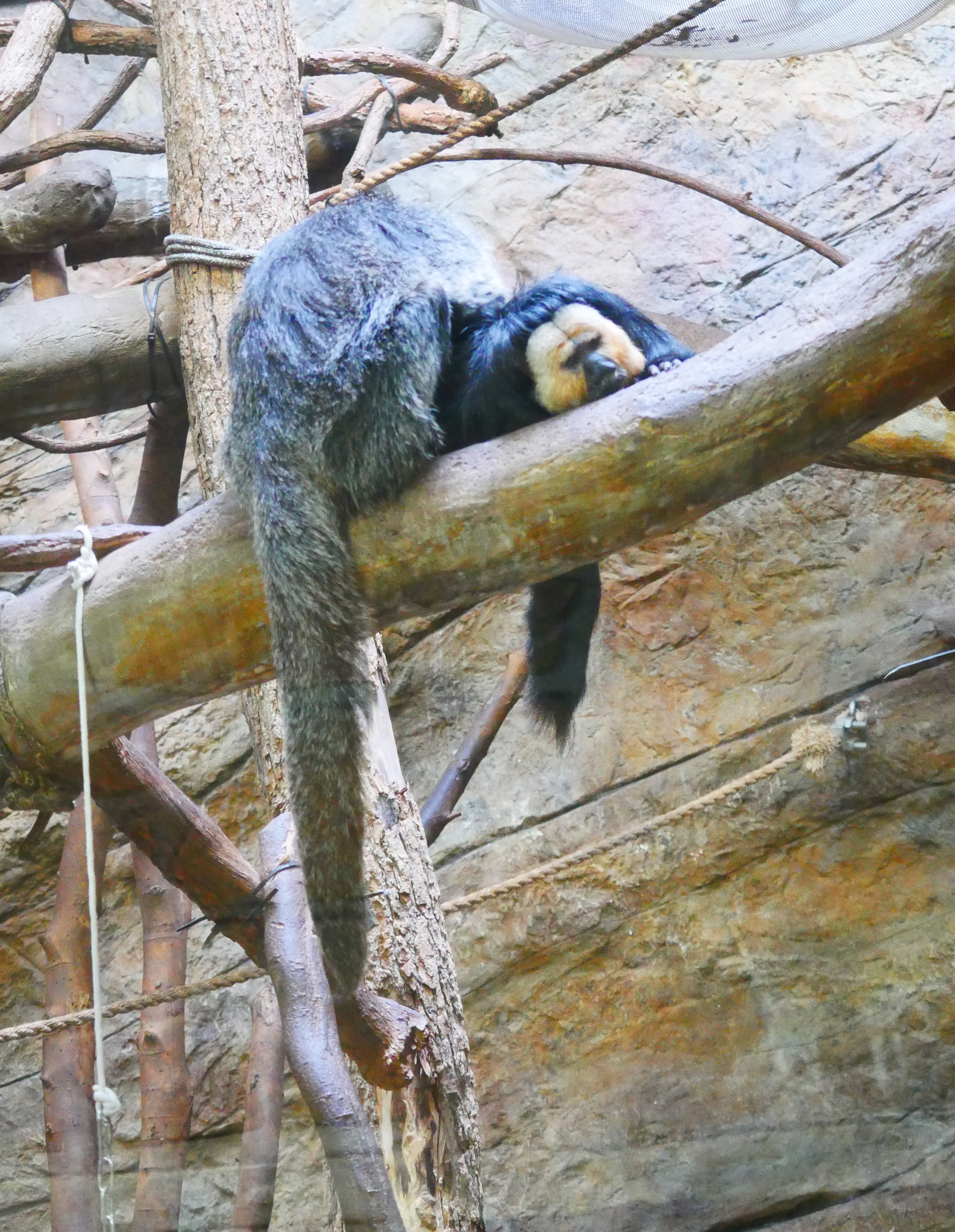
WHITE-FACED SAKI


TUFTED CAPUCHIN


Little Rock Zoo: Multi-habitat Wheels on the Edge

 Again, without geographic reference these areas are basically a Hodge-Podge.  By the time we'd gotten to this part of the zoo, the rain was setting in for a decent little shower.  So perhaps it was a blessing that most of the animals had more sense than us (or me, anyways.  My friend brought umbrellas!)

The first construction was a large circle with 8 separate habitats divided by faux stone to give the effect of a narrowing canyon on each of them.  The first three were labeled for otters, two species: North American River Otter, and African Spotted Otter.  All the water features which included falls, little streams and pools were turned off and dry save the trace moisture from the rain over the past few days and presently.  It was like a zombie apocalypse with the zombies.  We encountered one North American River Otter behind a little faux rock fold going to town on something edible--perhaps a zombie.

Continuing on around the complex, we discovered that the next three empty "Canyons" were identified as home to Sloth Bears.  The final two were marked "Under Renovation and hand areas of unkempt grass.  Apparently, previously home to Bush Dogs if you follow the Zoo Map's indication.

From here it was an easy walk in the rain to a smaller but similarly configured set of habitats.  These were shallower, and taller, and only three-quarters around.  The first one with an animal was home to a beautiful little Gray Fox who was wisely sleeping on a ledge that was shielded from the rain.  On the far end to the right in the last habitat, we encountered a Fossa.  One of the few I've ever seen and no sooner had I gotten one photo, she slipped away inside.  

Turning around to go to the end of the other side, we got the quickest of glimpses of a Chinese Muntjac who, started by us, flew away inside lickety-split!  We took this as a sign and made our own haste to the centrally located sit-down African Cafe.  We found ourselves in the company of a German couple and little child, and the Manager and his pre-teen daughter.  The manager was a super genial fellow who offered to toss in fries at no extra charge, as his daughter enjoyed bringing us our drinks and food.  The space was large but cozy with a roaring fireplace ablaze on the opposite side of the counter and kitchen.  Definitely recommend planning a stop here to refurbish your energy if you ever visit the Little Rock Zoo. 

The Otter/Bear Habitats.

The Third Otter Canyon.

The lone visible inhabitant of "Zombie Island"... a North American River Otter.

The second series of habitats

Cozy little Gray Fox


The elusive Fossa.

This stone placard was embedded in the stone wall of the foyer of the Africa Cafe.  It felt like it had once been ensconced somewhere else.  I love when institutions preserve and make reference to their history.

Africa Cafe

Little Rock Zoo: African Savannah

 After you leave the Big Cats, the pathway that makes the most sense leads you past a lesser primate habitat that appears to be flex, in that on any given day, a different species might be found there.  On this rainy day it was not surprising to find it empty; however, to our surprise we spied a pair of  Lesser Spotted-nosed Guenon,  spying us from a window perch in their interior habitat.

From here you see the multi-pen habitat of the Eastern Black Rhinos, a mother/son pair.  The young male, Kevin, who was born at the Little Rock Zoo (first and only...so far) was out and expressing all the lethargy of the gray day around him.  His mother, Andazi, made a brief appearance in the lower yard and then retreated to the dry interior.  Just below the Rhinos was a long multi-species yard with a quartet of Grant's Zebra, a duo of Blue Wildebeest, and the trio of Common Ostriches.  

We learned from a couple of keepers who were too happy to entertain our questions that the Zebra are a sort of family unit.  There is a mother who arrived at the zoo with her colt, Melvin.  At the time she was pregnant and gave birth to a filly, and then later another colt...though, the circumstances of that impregnation weren't revealed.  And they didn't name the little guy "Jesus," so I don't think it was a miracle.  Melvin?  The Wildebeest were a pair of unrelated males: Ernest and something starting with an "H" that was also folksy sounding.  When I asked how the Zebra and Wildebeest got along, one of the keepers said, "Melvin thinks he is one of them."

Peek-a-Boo!  I see you, too!

The collection of interconnected yards in the Eastern Black Rhinoceros habitat

Kevin, the young male Eastern Black Rhinoceros that was born at the Little Rock Zoo.

(Behind him are inflatable animals for a seasonal holiday display)

The large mixed species habitat.  There is what appears to be a small giraffe feeding station, but presently the zoo doesn't appear to be home to any members of this species.

Grant's Zebra, a subspecies of the Plain's Zebra, one of three distinct species of Zebra alive today.


Melvin with one of the wildebeest.  He is comfortable enough with Melvin to allow him to groom his forehead.

Blue Wildebeest and Ostriches

There are two species of Wildebeest: Blue and Black, and I do not think Black Wildebeest are part of any zoo in North America.