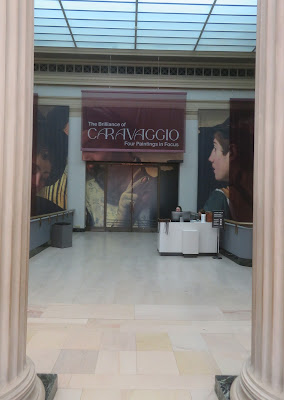
After lunch at the museum cafe, which was lovely, we returned to the galleries and the first of two paid special exhibitions. This one featuring works by the Renaissance master, Caravaggio.
A preface, during a former period in my life from the Autumn of 1994 through the summer of 2002, I had access to all of the Special Exhibition Opening parties at the National Gallery of Art, went to all of the staff Christmas parties, socialized with the business end of the curatorial staff as well as a couple of the folks who did the art restoration through whom I was given behind the scenes access to restorations of works by Winslow Homer, James McNeil Whistler and, yes, mister Caravaggio on separate occasions. I was even able to travel to other museums for Opening Galas for shows that had originated in DC and then traveled at places like the Philadelphia Museum of Art, the Metropolitan Museum of Art and even the Victoria and Albert Museum of Art in London.
Through these experiences and access to the folks who made the magic happen, I gained a unique understanding of these things. I watched while exhibitions came together, and also saw why some never got off the ground. It was mostly a pre-9/11 world, as well; which is very significant. Museums could find corporate sponsors willing to pull together mega shows which brought masterworks by an artist or on a theme from around the world together in one place and time. It really was giddy-ing. After 9/11 moving art from around the world basically stopped all together for a time. Things were just normalizing at a new, less extravagant level when Covid-19 tossed another wrench into the works. So through this period museums of sorts and sizes found new ways to tell stories and create interest for patrons to return.
This exhibition called "The Brilliance of Caravaggio, Four Paintings in Focus" not only purports to highlight the genius of the artist, but demonstrate the brilliance of the curatorial staff. It brings to the Toledo Museum of Art four masterworks by Caravaggio from four other major regional art museums: The Detroit Institute of Art, the Kimbell Art Museum (Fort Worth, TX), The Wadsworth Antheneum Museum of Art (Hartford, CT), and The Metropolitan Museum of Art (New York City, NY), and then pulls works by contemporary artists within the collection of the Toledo Museum of Art by artists who depict similar themes and use similar techniques possibly inspired by Caravaggio. The entire exhibition created a series of dialogues and conversations between the viewer and the paintings.
THE CARDSHARPS, circa 1595
First up, "The Cardsharps," circa 1595, on loan from the Kimbell Art Museum in Fort Worth, TX. In design, the painting depicts two fair and well-off youths playing a game of Primero. Behind then stands an older man. We know we should be wary of him, because he is unshaven (somethings never change!). One of the young men is examine his hand of cards contemplating his next move, while the other holds his cards tightly in his left hand. He appears to be leaning in toward the other player, eager for him to make his move. While his right hand is bent around behind his back where a pair of cards not in play are tucking into the sash. The older man is coyly peer over the first youth's shoulder at his hand and signally what he sees to the other. It is an ingeniously conceived composition of a common life moment full of moral, social, and cultural intercourse.
"The Fortune Teller," circa 1620
Valentin de Boulogne, 1591 - 1632
[French]
This painting is coupled with an equally engaging work called "The Fortune Teller," by French painter Valentin de Boulogne. In use of light and shadow, in theme (Life is rigged game of chance--especially without the presence of religion), and in the psychological richness with which the individual people within the composition are imbued. The two works aren't so much images and stories waiting to be discovered.
The Musicians, 1597
Second, "The Musicians," 1597, on loan from the Metropolitan Museum of Art in New York City, NY. Of the four works, this one is probably the most recognizable. Three young men sitting together, two looking at the view and one with their back us looking down at a music manuscript. Over the shoulder of the young man sitting farthest to the left is a angel who is looking down a section of grape vine with a bunch of grapes that it is holding in its hands. The grapes bring the suggestion of wine and the look on the face of the model most well defined suggests the consumption of wine.
"Portrait of a Musician," 1638
Jusepe de Ribera, circa 1591 - 1652
[Spanish]
This work is coupled with "Portrait of a Musician," 1638, by Spanish artist Jusepe de Ribera (1591-1632). Indicative of Caravaggio in this work are the subtle emotion on the expression of the face, and the use of light and dark to highlight specific aspects of the image. A characteristic more prevalent in some of the later works of Caravaggio's like "The Conversion of St. Paul on the Road to Damascus."
"St. Francis of Assisi in Ecstasy," circa 1595 - 1596

Next up, "St. Francis of Assisi in Ecstasy," circa 1595-1596 from the Wadsworth Antheneum in Hartford, CT. In this image, an angel hold the swooning St. Francis with arms outstretched receive the miracle of the stigmata (the bleeding wounds of Jesus Christ from the cross). The angel's expression of human tenderness is surpassed by the Francis' profound humility, a slight sparkle of tear descending from one eye. This painting was Caravaggio's first religious themed work, and he creates within the fullness of the canvas not only a profound composition of the good Saint Francis and Angel, butt a rich tapestry in the murky areas surrounding the main characters. Just below Francis' left hand is a flower, a common daisy. It's suddenly blooming, but the actual plant only blooms in sunlight. It is the symbol of the Virgin Mary, as well. Behind him are disciples sleeping against a tree--a reference to the abandonment of Christ by his friends on the eve of his crucifixion.

"Lot and His Daughters," circa 1636 - 1638
Artemisia Gentileachi, 1593 - 1653
[Italian]
From the collection of the Toledo Museum of Art one of the works paired to this painting is by Artemisia Gentileschi (1593-1653). She is perhaps the best known female artist of the Italian Renaissance, and like Caravaggio and artist with an outsider's perspective. Caravaggio was not a devote man, in fact, quite the opposite. When approaching religious themes, he often brought a degree of humanism that we would readily relate to today, but that must have seemed odd at the time. Compelling, no doubt, but nonetheless odd. Artemisia brought a feminist's lens to her works and often chose Biblical themes were previous artists had portrayed the women as the villains. She would elevate and humanize them. So, apart from the stylistic similarities, you have this painting of Lot's daughters seducing him without the salacious elements commonly found in works by men of bare breasts and wanton expressions; rather the daughters are seen as focused on a task that they believe is the only way to save the human species. They are not sleazy harlots game for some incestuous fun. They are valiant women about to do for the greater good what no man on his own can. Don't you just fucking love art?!
"Martha and Mary Magdalene," circa 1598
Finally, from just up the pike on loan from the Detroit Institute of Art, "Martha and Mary Magdalene," circa 1598. Again, Caravaggio was not a religious man. His association of Mary and Martha the sisters of Lazareth with Mary Magdalene the reformed prostitute was an understandable confluence of Biblical characters. Under Caravaggio's brilliant hand (with the added meaning of Mary's backstory) the painting becomes something so much greater than the sum of its parts. I simply fell in love with this one.
Martha is on the left and Mary is center stage with her left arm draped over a black orb, her left hand indicating a patch of light glare on its surface. A burst of light that represents spiritual enlightenment. Her right are is drawn up to her solar plexus and in her right hand is an orange blossom, symbol of purity and innocence. Her face glows in the reality of her encounter with Christ, while Martha looks on in the very moment of recognition. Her sister has been born again.
Before we went to the museum we attended morning Eucharist at St. Andrew's ECUSA in Toledo. After the service, we descended into the fellowship hall of coffee and donuts. As we mentioned our plans to visit the Toledo Museum of Art, someone would say, "Oh, the Caravaggio exhibit is there." and/or "You have to see the Caravaggio exhibit." Having seen it--I understand their excitement. Just the perfect little expression of his "brilliance" and influence on others of his and the next generation of artists. As it closes tomorrow, April 14th--we caught none too soon.