Showing posts with label Cleveland Metro Zoo. Show all posts

Saturday, July 12, 2025

Cleveland Metro Zoo: Wilderness Trek

 The final area is a wee bit of a walk up the ridge and just beyond the Fulton Street overpass.  It's a hodgepodge of North American and Asian species.  The habitats are well designed with culturally relevant elements and detailing.  One of the most interesting belonged to the Amur Tiger.  Multiple areas with connecting pathways.  Unfortunately no Tigers present. 

Some of the animals that were present included: Reindeer, Sichuan Takins, American Bison and California Sea Lions.

About halfway up the pathway to the Wilderness Trek which starts on the other side of the viaduct visible through the trees.  It's a bit of a hike.

REINDEER
Rangifer tarandus

Another Reindeer was standing in the pool of water to stay cool.


SICHUAN TAKIN
Budorcas taxicolor tibetana

I love Takin so much!


The expansive American Buffalo habitat

AMERICAN BUFFALO
Bison bison


Sea Lion Habitat


SEA LION
Zalophus californianus

Cleveland Metro Zoo: African Savanna


 The largest area of the zoo is committed to animals that call the Savanna region of Africa home.  Representing are Masai Giraffe (the less common of the two species in zoos in the Eastern half of the U.S.), African Lions, Grant's Zebra, Saddle-billed Stork, Bontebok Antelopes (also not common in US zoos), Ostriches and Eastern Black Rhinoceros (which are Critically Endangered in the wild; unlike the other species of Southern White Rhinoceros which have made a miraculous recovery from the brink of extinction since 1900).  By the time time I got here it was 1 PM, and the temps were in the low 90's F.  The sun was bearing down on everything, and the animals were all looking for shade or coverage.  I saw no evidence of Zebra, Bontebok, Ostrich or Lions.  Again, this is the game one plays when visiting any zoo.  I've seen a lot of lions in my visits.  I've only once seen a Fossa, and it was rather fleeting at the Little Rock Zoo--so the time I spent earlier with a Fossa here was amazing.  

What I appreciated most about this zone was how expansive the habitats are.  Animals really have the opportunity to explore large areas by any urban zoo standard and the fact that vegetation was able to thrive really tells the tale.  I did see a saddle-billed Stork from a distance before moving on, but being that it is not that amazing of a bird and the far distance, I did what I do so often and just admired it.  At the entrance were a flock of what I believe were Chilean Flamingos.  
CHILEAN FLAMINGO
Phoenicapterus chilensis


The first of two large habitats for Eastern Black Rhinoceros.  This one was inhabited by a lone male.

EASTERN BLACK RHINOCEROS
Diceros bicornis michaeli


A hot day and a good ole' clay wallow.

The second habitat enclosed two females.


Lunchtime for the Giraffes!


The youngest Giraffe's spats are so pristine compared to the older members of the herd.

MASAI GIRAFFE
Giraffa Tippelskirchi

Friday, July 11, 2025

Cleveland Metro Zoo: African Elephant Crossing

 You look at what is at the heart of some zoos and it's a statement about who they are and what they cherish.  Others just end up with things in the middle by chance.  You get the feeling at the Cleveland Metro Zoo that the multi-acre habitat devoted to their little herd of African Bush Elephants speaks volumes.  Over the past couple of Decades, Elephants have become a hot topic at zoos.  Traditionally, kept by many small zoos, circuses and even some roadside menageries, the care of Elephants has been frankly somewhere on a scale from lacking to atrocious.  

One of the major rolls of the Association of Zoos and Aquariums is to develop and upgrade standards for animal care.  Using the collective expertise of its thousands of member keepers, veterinarians, researchers, scientists and the best minds available in academia, they created committees to manage the various species as though they were one unified collection.  This allowed them to move animals between institutions in order to fill needs, and satisfy the optimal breeding recommendations.  At the same time, the level of care for each species also came into play.  Issues around dietary needs, a collective database of medical care and techniques developed to meet the unique needs of some species.  Psychological well-being with consideration to the socialization needs of various species which also led to best practices regarding institutional population sizes and the design and size of holding facilities and habitats were also added into the comprehensive mix and rubrics by which institutions are judges regarding recommendations and accreditation.  

AZA might seem like just a couple of letters attached to the logo or presented on the literature, signage and websites of members, but unlike other zoological associations, membership means meeting or realistically achieving rigorous standards.  Standards that are constantly being reviewed and when necessary revised upward.  Few animals have received the scrutiny that has been applied to Elephants, both Asian and African, in the development and maintenance of these high-care, state-of-the-art expectations.  

In the short time that I have been associated with the AZA and aware of this process, I've witnessed how some zoos--some major American and Canadian zoological parks--have chosen to deaccession Elephants from their campuses rather than make the necessary high-cost investments to meet AZA standards or because the AZA standards create requirements of habitat design that exceed their available space to grow.  Among these institutions has been the Philadelphia Zoo, the Virginia Zoo, the Woodland Park Zoo, the Calgary Zoo and the Buttonwood Park Zoo in little New Bedford, Massachusetts.  The Maryland Zoo in Baltimore spent more than 12 million dollars in the 20 million dollar renovation to up-grade their decent African Elephant Habitat into one that meets new standards.  The Denver Zoo completed a similar multi-million dollar up-grade as did the Smithsonian National Zoo in Washington, DC.  All three are amazing.  And all three are or are slated to become geriatric elephant holding facilities. 

Even as a member of the AZA with lots of access to amazing information, the organization keeps the particulars of the Elephant program under wraps because of how some reactionary animal rights groups have used the care of these animals as a cause to create uproar and fund-raise. 

But back to the Cleveland Metro Zoo's African Elephant Crossing.  The multi acre habitat featured two large exterior areas and potentially smaller spaces that can be cordoned off when necessary.  There is a central plaza that gives viewing opportunities to both as well as access to the Elephant Barn.   Inside the barn are areas where the African Bush Elephants may be viewed during inclement weather and colder seasons.  This space contains education displays and interactive models pertinent to the lives of African Bush Elephants.  There are also habitats for Naked Mole Rats and African Rock Pythons--adjacent species.  Out in the plaza are gift shops, food court and seating options (all of which were not open--on July 4th!?  That was odd.)  Also there is a colony of Slender-tailed Meerkats.  

This opportunity coupled with a similar experience at the Pittsburgh Zoo the day before, are the most I've seen African Bush Elephants well cared for and engaged socially in a while.  They are amazing creatures.  Whatever we can do to support their quality of life and survival in the wild is our legacy to the future.  


The Plaza at African Elephant Crossing from one angle.

AFRICAN BUSH ELEPHANT
Loxadonta africanus


Entrance to the Elephant Barn

Meerkat Habitat

SLENDER-TAILED MEERKAT
Suricata suricatta

Cleveland Metro Zoo: Australian Adventure

 The Deck Walk from the hilltop Primate House ends up across from the Australian Adventure area.  Without a map, it was unclear where anything in particular might be.  There was evidence of Koala Bears, but no clear indication where I could go to possibly experience them...so I didn't find them.  The whole area was designed with rural structures with names reminiscent of the Outback.  I went through a Kangaroo & wallaby walk-through.  More buildings beyond, but nothing seemed open: snack sellers, eateries, gift shops.  I stopped at a Dingo habitat, but no animals were there.  In general, not much to see or do.

Kangaroo and Wallaby walk-about.

RED-NECKED WALLABY
Notamacropus rufogriseus


Cleveland Metro Zoo: Primate, Cat and Aquatics

 "Primary, Cat & Aquatics" has to be one of the most idiosyncratic titles for a zoo zone in the country.  But you get exactly what's advertised.  Well, as long as they (the Cheetahs) are out--but they weren't.  So the actual experience for this visit would be "Primate & Aquatic"--now what you have is 1/3 of the Xindi continuum.  (Bonus Points for catching the niche reference!)

The structure sits atop The highest hill and can be accessed by taking a gas powered tram, or you can walk either the continuously curving black-topped pathway with a set gradient or the switchback "Deck Walk" that twists and turns its way down a steep and old growth forested hillside.  I went up on the tram and back down the Deck Walk.

The tram deposits you in front of a building that is home to a small aquarium section, a lot of small mammals most of which are primates, and the zoo's Western Lowland Gorilla troop.  The interior habitats are spacious, well appointed and include live plants.  Many are interconnected allowing for flexible habitation.  A handful of others also connect to huge exterior habitats given the inhabitants lots of choices in conjunction with the weather and season.  

I met a volunteer there and we had a lovely conversation.  At one point I found myself asserting that this was one of the nicest smaller primate houses I'd ever experienced.  My visit ended with a view of the wildly popular Gorilla troop and its entertaining youngest member.  Turning to leave I noticed the empty grassy habitat and only discovered later that it is home to Cheetahs who were not out at the time. 


The lobby leads you into the primate side of the structure and exits you from the little aquarium section.

NORTHERN TREE SHREW
Tupaia belangeri

Three of the many interior habitats.

WHITE-FACED SAKI (female)
Pithecia pithecia


PIED TAMARIN
Sanguinus bicolor


The surprise inhabitant in the midst of the Primates was this lovely, exotic Fossa.

FOSSA
Cryptoprocta ferox


MONGOOSE LEMUR
Eulemur mongoz


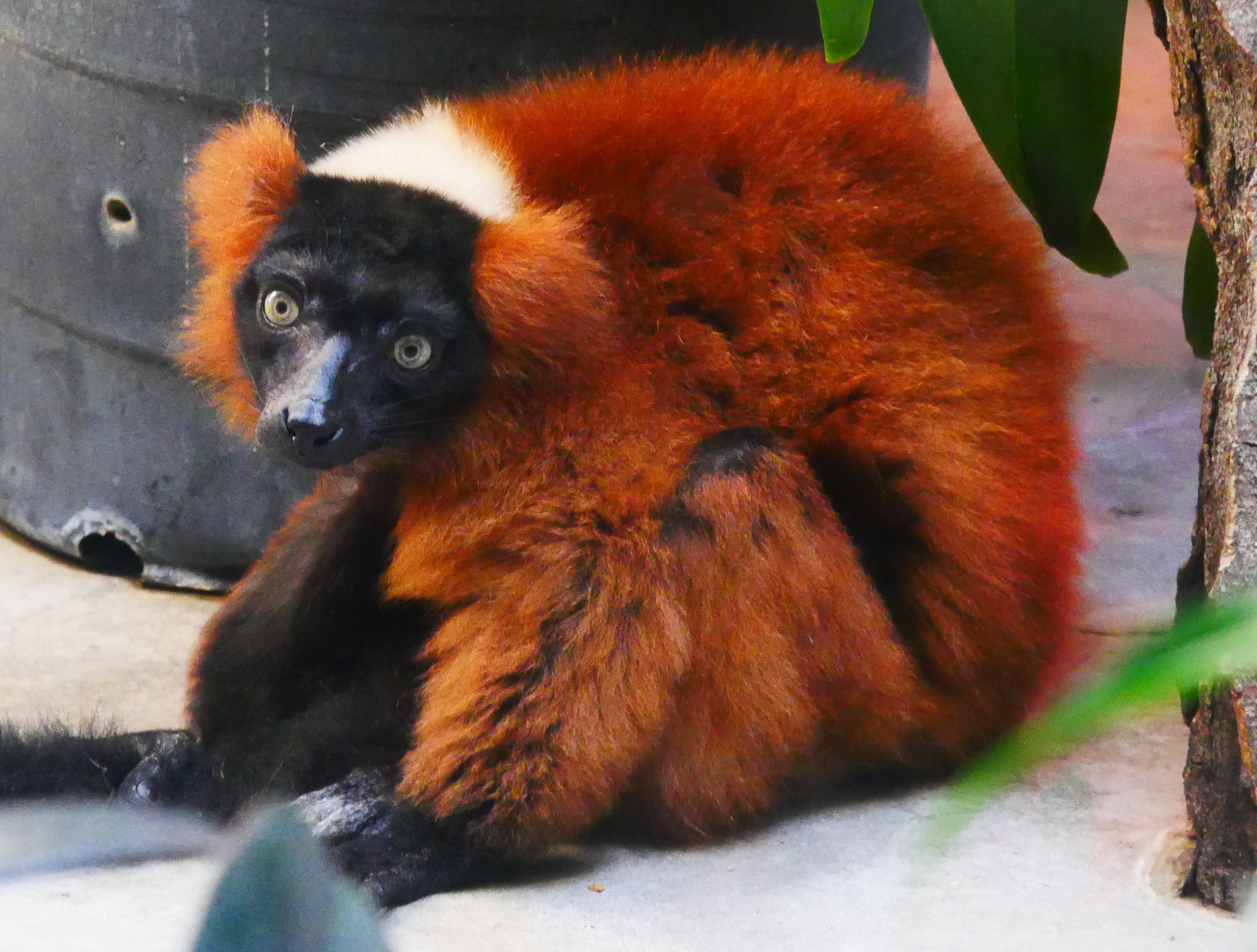
RED RUFFED LEMUR
Varecia rubra

Scenes from the Aquarium.


EASTERN HELLBENDER
Cryptobranchus alleganiensis


Primates scuttle through a habit-tube to go between the interior and exterior portions of their habitats.

ALLEN'S SWAMP MONKEY
Allenopithecus nigroviridis


GOLDEN-BELLIED MANGABEY
Cercocebus chrysogaster


WESTERN LOWLAND GORILLA
Gorilla gorilla gorilla


Walking away towards the upper entrance to the Deck Walk.