Monday, August 19, 2024

Philadelphia Museum of Art: Mary Cassatt At Work

 This is my first Mary Cassatt retrospective.  How delightful!  

When I think of her art, I am immediately surrounded by images of women and women with children.  She took the Madonna and Child motif and secularized the hell out of it!  Her work is a little hard to pin down.  She definitely embraces the whole impressionist vibe when it comes to the essential ethos of her work.  They exude a sense of calm and serenity--it's palpable, and that's perhaps the biggest part of her magic.  

Because technically, she is not a naturally talented artist.  Her sense of perspective is at times bizarre.  Her grasp of anatomy can be awkward, and yet she nearly always ameliorates this aspect of her art with compositional prowess.  In these aspects, she wasn't out of step with her contemporaries: most notably Gustave Caillebotte and Pierre-Auguste Renoir.  Yet you love her still because her genius doesn't rely on these elements.

One of the things that really came home to me in this exhibition was her multi-medium expertise.  Cassatt was equally wedded to creating works in Oil, Pastel, and Etching.  On some level I was aware of her works in each of these arenas, but seeing so many of them together with the opportunity to 1) witness her evolution, and 2) compare her skill across all three.  I have to say that of all three, I was least enamored of her oil paintings, and utterly mesmerized by her pastel works.  

As to Cassatt's prints, the exhibit takes great pains to include not only a wide range of works, but a few that illustrate the multiply layered steps from first to last in the process of Drypoint, Soft-Ground-Etching, and Aquatint.  I always love it when I learn something new about art in general while experiencing an Artist specific exhibition.  I did count the number of works, but I would guess there were 125 works altogether.  The collections of almost all of the major American Art Museums were represented.  From Philadelphia the exhibition travels to San Francisco's Fine Art Museum at the Legion of Honor.

SELECTED OILS
IN THE LOGE
1878
Museum of Fine Arts, Boston

CHILDREN IN A GARDEN (THE NURSE)
1878 - 1879
Museum of Fine Arts, Houston

THE CHILD'S BATH
1880
Los Angeles County Museum of Art

LYDIA CROCHETING IN THE GARDEN OF MARLY
1880
The Metropolitan Museum of Art, New York City

DRIVING
1881
Philadelphia Museum of Art


SELECTED PASTELS
A GOODNIGHT HUG
1880
private collection

THE BANJO LESSON
1894
Virginia Museum of Fine Art, Richmond

WOMAN IN A BLACK HAT AND A RASPBERRY PINK COSTUME
1898
private collection

SELECTED PRINTS
(Drypoint, Soft-Ground-Etching, and Aquatint)
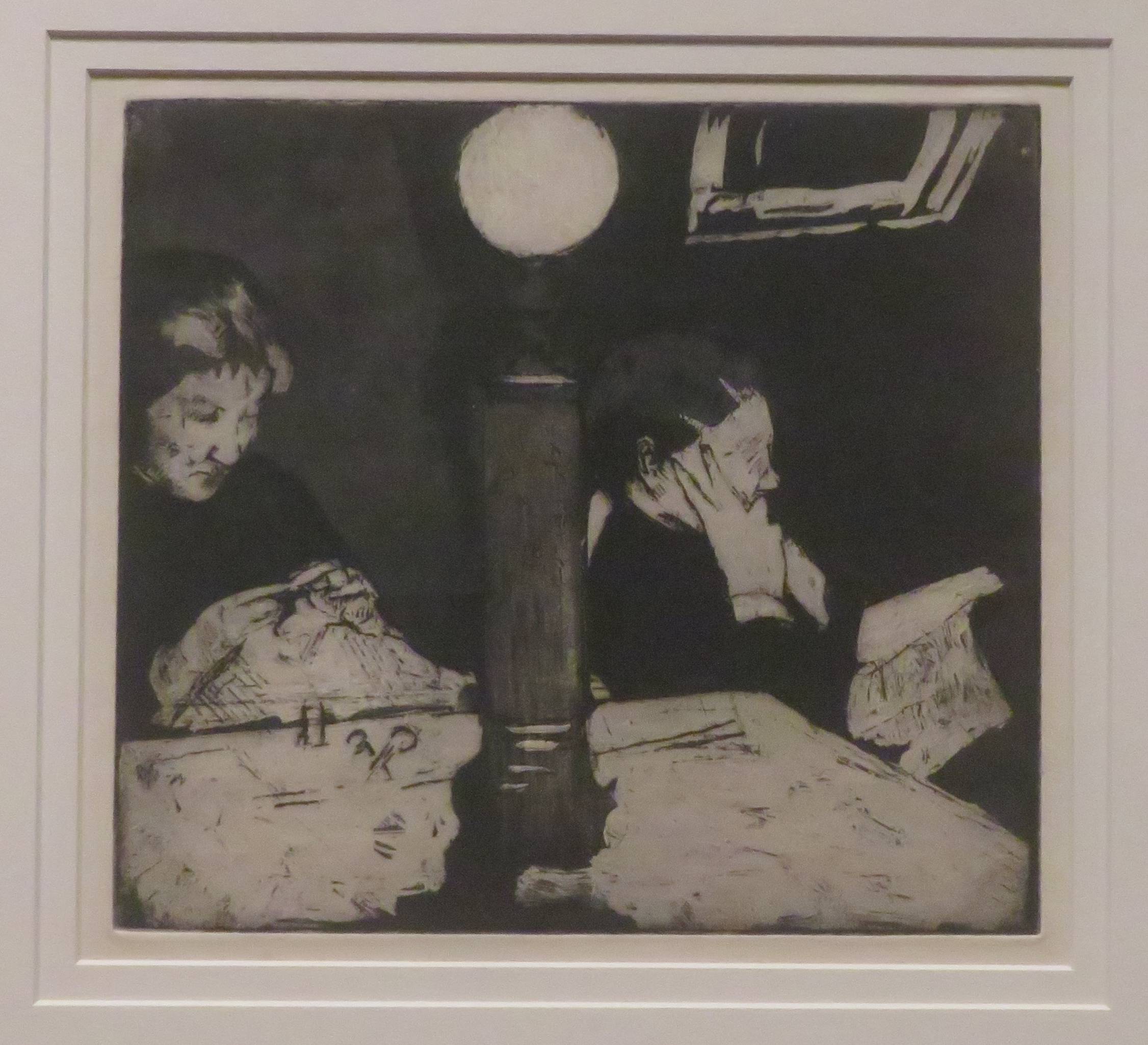
UNDER THE LAMP
circa 1882
The Art Institute of Chicago

THE BATH (1st Print)
1890 - 1891
Adelson Galleries, New York City

Prints demonstrating the full range of the process.

THE BATH (12th Print)
1890 - 1891
Adelson Galleries, New York City

THE LETTER
1890 - 1891
private collection

FEEDING THE DUCKS
circa 1895
private collection

Sunday, August 18, 2024

Philadelphia Zoo: Final thoughts

 Leaving the Big Cat Falls habitats of the Philadelphia Zoo, I placed my sights on the exit.  To get there I crossed from the west side of the zoo to the east passing along my way the former small mammal house which has been converted into a Spider House.  This is completely fitting given the creepy state of the place on my previous visits.  I did not go in to check it out.   I also passed the Federalist Style mini-Mansion called The Solitude that was the original estate on this land.  It was built and owned by one of William Penn's grandsons.  

Finally, I ended at a crossroads with Flamingos to my right, and the path to the exit on the left.  Choosing left, I soon encountered the space that has been home to Red Kangaroos and Emus.  Only Emus were out on this day.

A fiscal reckoning of the adventure would come out to: $102.90. 

This would include:

1 - $35.90 in gas for my car
2 - $18.00 for highway tolls along the way
3 - $43.00 for admission and parking at the zoo
4 - $6.00 for a pretzel and mustard

Excluded: 

1 - Other food
2 - Admission to the Philadelphia Museum of Art
3 - Parking at the Philadelphia Museum of Art


Philadelphia Zoo: Big Cat Country

 From the McNeil Aviary Center at the Philadelphia Zoo I went on a sort of "goose chase".  Heading south toward the end of the zoo, I hoped to see some the of the amazing animals that I had encountered there in the past: Cheetahs, Maned Wolves, Black and White Colobus Monkeys, American Bald Eagles.  It was an uphill slog as well, and so took a little effort on my part vis a vis my recent surgery.  Result?  Utter disappointment.  Colobus Monkeys and Maned Wolves are no longer there.  The Ground Hornbills that replaced the Maned Wolves and the Cheetahs were not out.  I had two heat-lethargic American Bald Eagles to look at...  The whole area felt like it was ripe for a complete redevelopment.  

Turning back around, I could at least be happy that it was downhill!

So I went to the final big ticket habitat: Big Cat Falls.  This is a collection of habitats with interior holding areas that are potentially home to five species: African Lions, Tigers, Pumas, Leopards and Snow Leopards.  Over the years and visits I have seen 4 or the 5.  I've never yet seen a snow leopard.  based on the limited information on the zoo's website, I am led to believe that they currently at least have Amur Tigers, African Lions and North American Pumas on site.  On this visit--not surprisingly--in the heat of midday, I only saw two.  A Tiger.  And a Lion.  There is never a reason to feel disappointed when you get to see a Tiger and Lion.
AMUR TIGER
Panthera tigris altaica
Conservation Status: Endangered


AFRICAN LION
Panthera leo
Conservation Status: Vulnerable


Philadelphia Zoo: McNeil Avian Center

 Continuing up the path along the outer edge of the Philadelphia Zoo from the Red Pandas didn't make much sense.  There's only a barn owl, if it was even there.  So I turned and headed across the zoo toward the McNeil Avian Center.  It's a lovely space with five areas containing birds.  One of their claims to fame has been their breeding of the Guam Kingfisher and the Guam Rail, both of which are extinct in the wild. 

When you first enter, you encounter a large arch revealing a jungle.  What isn't readily apparent is the mesh netting on either side of the wide arch creating an enormous cage.  In all my past visits a pair of Rhinoceros Hornbills resided there.  On this visit, it appeared to be almost empty, save the lush plants and a single (what appeared to be) Blue-tailed Trogon.  

IMPORTANT ASIDE:  I wish I could have used the Zoo's website to confirm this, but honestly, post visit, I found the Philadelphia Zoo's website in regards to its animals the most pathetic and disappointing website I have ever encountered.  They claim to be home to 1,900 animals, but you'll only find information on 19 there: that's 15 mammals, 2 birds, and 2 reptiles.  They have a drop down that includes amphibians, but no examples. They have a search feature, but if you deviate from one of the nineteen present on the front page from the link, you will get the message "No Results Found".  Now, maybe it's a work in progress, I don't know, because there is nothing anywhere on the page to suggest that more is coming at all.  

From here you turn right and make a letter "C" that will take you through four aviaries (three sort of small) around to the back side of the arch and out again into the lobby on the opposite side.   Since my last visit they'd replaced the open space with a thick close wire mesh in the first room.  The effect makes it impossible to take photographs.  The room is home to shore birds and a little flock of yellow weavers from Africa.  The next space is the smallest and is subdivided into three areas.  One for the Guam Kingfishers, another for the Guam Rail, and the third for a handful of little tropical Pacific Island song birds.

From here you enter the largest room where in the past I would count on observing around 10-12 species.  On this visit, the place was rather quiet.  I noted three species.  I asked a keeper watching the room about one of them, but didn't inquire beyond that.  It was a little disappointing.  In the last room the set up is to look like a Central American Coffee Plantation.  The signage educates guests on the relationship between the agricultural industry and the birds that exist on and around such farms.  It's a nice set-up and there were half a dozen birds in the space, but the glare on the mesh netting made photography impossible here, too.

My overall impression was a bit of a letdown based on past experiences.  I missed the Hornbills, as well as the Green Aracari and the Golden Pheasant that once called the large walk through aviary home.  

The spacious foyer with its tall, arched aviary.  On the other side is the walk-through aviary.

VICTORIA CROWNED PIGEON
Goura victoria 
Conservation Status: Near Threatened

The zookeeper with a ground bird in the walk-through aviary that I failed to identify.

BEAUTIFUL FRUIT DOVE
Ptilinopus pulchellus
Conservation Status: Least Concerned

Philadelphia Zoo: Aqua: Water Is Life

 The last opportunity of note along this path is a relatively new collection of habitats under the title: "Aqua: Water Is Life."  It is designed with faux rock to feel at times like a cave and at others like a hike through a narrow canyon.  The two major species featured are Red Pandas (Asia) and Giant River Otters South America).  There is also a habitat where species of Bats have been housed; however, today it was occupied by three species of birds, Hamerkopf, and two types of duck.  The title might seem odd, and I think it is, too.  Yet it's justified by the fact that throughout the space educational placards teach about the precious and threatened status of water along with conservation tips and challenges.

On this visit, besides the birds, the Red Pandas were out.  The Giant River Otters weren't, which was a shame, because they are so much larger than our North American River Otter.  Giant River Otters live in the Amazon River basin where an adult male can top 70 lbs!  A fully grown North American cousin would be straining to make 18 lbs.  Last time I was here they had two breeding pairs, and the space is large enough that it is possible to keep both in separate areas of the habitat complete with their own access to the flowing water feature.

The bottom line on these habitats is that they are light speed ahead of what was here not that long ago.  On my first trip the first animals I encountered after passing the camel ride, were a pair of Red Panda in a rather small wire covered wooden frame cage.  Things have changed so much for the better.


The entrance to Aqua: Water Is Life habitats.

RED PANDA
Ailurus fulgens
Conservation Status: Endangered


HAMMERKOPF
Scopus umbretta
Conservation Status: Least Concerned

SPOTTED WHISTLING-DUCK
Dendrocygna guttata
Conservation Status: Least Concerned

Philadelphia Zoo: African Savannah

 Continuing in the same direction leaving the Bear County habitats you come up on a series of habitats that flank the outer edge of the zoo off of 34th Street, but you'd never know it was their thanks to their design with naturalistic rock walls and thick vegetation.  From first to last you'll discovery Southern White Rhinoceros, Plains Zebra, Reticulated Giraffe and Hippopotamus.  On the opposite side of the path is large meadow habitat.  Over the years, it has been home to many species of antelope and gazelle.  On the first visit there were Addax and Addra Gazelle, both species that are Critically Endangered.  On other visits, the space was uninhabited altogether.  On this visit I found an interesting duo of species: Watusi Cattle with their impossibly humongous horns! and Red River Hogs.  As I enjoyed the animals, I happened upon a keeper chat and feeding at the Giraffe habitat.  


SOUTHERN WHITE RHINOCEROS
Ceratotherium simum simum
Conservation Status: Near Threatened

PLAINS ZEBRA
Equus quagga 
Conservation Status: Near Threatened


RETICULATED GIRAFFE
Giraffa reticulata
Conservation Status: Endangered


COMMON HIPPOPOTAMUS
Hippopotamus amphibius
Conservation Status: Vulnerable

ANKOLE-WATUSI CATTLE
Bos taurus ankole
Conservation Status: Least Concerned


RED RIVER HOG
Potamochoerus porcus
Conservation Status: Least Concerned