Saturday, April 20, 2024

Detroit Zoo: Bears, The Arctic Ring of Life

 The very heart of the upper extent of the Detroit Zoo is a very large (the largest I've ever seen for Polar Bears) habitat called "The Arctic Ring of Life"(U).  It so large that we walked nearly around the entire circumference admiring all of the design and open (empty) spaces before we came to the habitat for the Pacific Sea Otter (T).  A wonderful large pool with both over ground and below water viewing areas, but no Sea Otters.  

We came to a cabin that gave guests access to below water viewing of the Polar Bear.  Nearby, was another large viewing area.  Most of the folks around us were grumbling over the lack of any Polar Bears.  I noticed one women at the far end of the viewing area with a young girl.  Both were staring intently.  I thought that they must be looking at something.  Indeed, they were watching the Polar Bear.

On the far side of the habitat is a series of habitats with high cliff wall backs (S).  They were home to a trio of Grizzly Bears and a North American Black Bear.  None of which were out.  They could very easily still be burmating.  I wasn't surprised at their absence.


A view of the far side of the huge habitat.

Pacific Sea Otter habitat.

Polar Bear
Ursus maritimus


The underwater viewing room in the Arctic outpost cabin.


Detroit Zoo: Africa II

 Beyond the Rhinos you come to a restaurant (Closed), the furthest nexus of the narrow gauge railroad (Closed), and habitats with mostly ungulates.  The Warthogs were out, but so far away and laying low sleeping that they were not ready for their "close ups," Mr. DeMille.  The only restroom open was a pair of large porta-potties.  I've relieved myself in worse, though the little girl and mother using the one next to me were possibly traumatized for life--I made sure to keep noises to a minimum.

Of the animals advertised, almost half were out.  Again, the temps at this point were in the low 70's.  A trio of male Grevy's Zebra (P), three Reticulated Giraffe (Q), two Common Elands, a Common Ostrich (O), and one Giant Anteater (R) resident in the habitat of the Sulcata Tortoise--a refugee from the new children's play area redevelopment.  Absent were Thomson Gazelles, Blue Wildebeest, Aardvark, Meerkats, and the aforementioned Tortoise.  I get the tortoise, the day would work for them, but it's still a little early.  Nice images and opportunities to see those that were present.  The habitats are spacious.

Common Eland
Taurotragus oryx

One of the three Elands was missing a horn.

Members of a genus with 9 total species of Antelopes, others include, Kudu, Bongo, Nyala and Sitatunga.  The Eland (Giant and Common) are the most bovine-like.

Common Ostrich
Struthio camelus 
(male)

Zebra (and Antelope) Habitat, although only Zebra were present on the day I visited.

Grevy's Zebra
Equus grevyi

There are three species of Zebra: Mountain, Plains, and Grevy's

Grevy's are impossible to mistake with their super narrow stripes.

One male grooming another.

Live for moments like this!

Giraffe habitat and barn in the background

Reticulated Giraffe
Giraffa reticulata
(male)

Jabari is the bull of the Detroit Zoo's Giraffe herd of five animals

The Warthog habitat is also ginormous, and the warthogs were taking full advantage of this and were sleeping at the very far side of the area.

Habitat listed as home to Aardvark and Tortoise space; however, currently home to the zoo's Giant Anteater.

Giant Anteater
Myrmecophaga tridactyla


Friday, April 19, 2024

Detroit Zoo: Africa I

 At this point in our visit I am going off chronology for the sake of efficiency.  You see we started to visit some of the African Animal Habitats when we realized we were hungry (it was already after 1 PM).  We'd arrived at the zoo shortly after it opened at 9 AM.  Without a map, we made out best efforts at finding a placard map and we asked no fewer that 3 employees (keepers at 2 different places and a trio of security officers)  Honestly, it damn near impossible to locate the only restaurant open in the place.  

Therefore I will describe the African habitats in two parts, and then the Arctic Habitat, and finally the ones we saw on our way out.  Around the Flamingo habitat and  wee walk you come to the African Lion habitat (L) with one Male and three female  members in the Pride.  The male, Simba, arrived at the Detroit in 2012 from the emirate of Qatar where he'd been owned by the Royal Family.  Doing the math, he's at least 14, which is in the twilight years for a lion.  Few live beyond 17 in captivity.  The females Asha and Amirah are sisters who were both in 2016 and came to the zoo in 2019 under a SSP breeding recommendation.  In 2020, Asha gave birth to Binti, the third female in the Pride.  Binti's birth was the first at the Detroit Zoo since 1980.  

Attached to the Lion Holding building is a habitat (M) with a large "mountain" feature home to a troop of Japanese Macaques.  The original use of this habitat was probably for some other species as Macaque are not African, and there is no water feature which is a noted characteristic of Japanese Macaques--they have an affinity for water and swimming.  The colony at the Detroit Zoo is 11 members strong.

Inside the holding building for the Lions and Macaques is a guest friendly passage with a standing Aviary, home to a flock of little black and white birds who's name I failed to copy down.  Across from this is a large holding space with a "Stadium Seating" sort of rock wall with tree trunks and ropes and other opportunities for the inhabitants to exercise and explore.  The space is more than two stories tall, with the lower portion out of sight of guests.  The signage suggested that little groups of Ring-tailed and Red Ruffed Lemurs call the space home.  We could here mucking around in the lower area, but only one of the Red Ruffed Lemurs ever made their way up into view.  The zoo is home to two brothers who were born in 2018, so relatively young Lemurs.  They share the space with four Ring-tailed Lemurs who were rescued from the illegal pet trade.  Both species are endangered in the wild.

Across from the Macaques a separate habitat was home to a pair of Southern White Rhinoceros (N).  The Detroit Zoo is home to a pair of males, Jasiri and Tamba.  They are first White Rhinoceros that the Detroit Zoo has had in its collection.  They arrived at the Detroit Zoo in 2005, Jasiri is 24 and Tamba is 23.


African Lion Habitat with a facade of 17' high reinforced plexi-glass.  Not bad for viewing, not great for photos.

African Lion
Panthera leo

Binti grooming one of the older females.  Bird dots to help birds avoid collisions form patterns on the plaex-glass.

Japanese Macaque Habitat.  I wonder whether it was home to an African species in the past, maybe Baboons.

Japanese Macaque
Macaca fuscata

All apes and monkeys sleep a lot more than humans do.  


foraging among the newly blooming ground ivy, the newest member of the colony Koi (born in 2022) is in the center.

Aviary inside the Holding Building

Interior Lemur habitat across from the Aviary

Red Ruffed Lemur
Varecia rubra

Southern White Rhinoceros
Ceratotherium s. simum

Jasiri (24) and Tamba (23)

Detroit Zoo: Great Apes and Flamingoes! Let's Dance

 From the Asian Forest area, we followed the sign posts to the Harambe Great Ape House.  This is the large holding with interior habitat space for the Detroit Zoos troop of Western Lowland Gorillas and their troop of Common Chimpanzees.  Both species were inside.  ON either side of the structure are large, open, spacious exterior habitats for both species.  On such a warm, bright day, I hoped that I could have seen them outside.  While there interior spaces were certainly large and well appointed by AZA standards, I also found the Chimp's interior space in need of cleaning.  At the Maryland Zoo, they cover the floor in straw and wood chips to give the Chimpanzees a more natural ground cover.

The story behind the Western Lowland Gorilla (Gorilla gorilla gorilla) is an interesting one.  Most zoos establish a viable troop and then over time through breeding or moves with the AZA institutions add a gorilla here, remove a gorilla there.  For the past 20 years, the Detroit Zoo had been home to 3 related males.  As other Gorillas died or moved on the core of their troop were these three step-brothers.  Then last July, all three were transferred to other AZA institutions on breeding recommendations, and in September an entirely new troop came to call the Detroit Zoo home.  The Silverback male Mshindi (36), and two of the females Bandia (25), and Tulivu (20) all came with existing relationships from the Cincinnati Zoo, and a third female, Nayembi (11) was transferred from the Lincoln Park Zoo in Chicago

The other large interior habitat was home to the zoo's Chimpanzee troop.  With twelve members, and three of them young: Jane (6), Zane (4), and the newest member, Tai, now 11 months.  

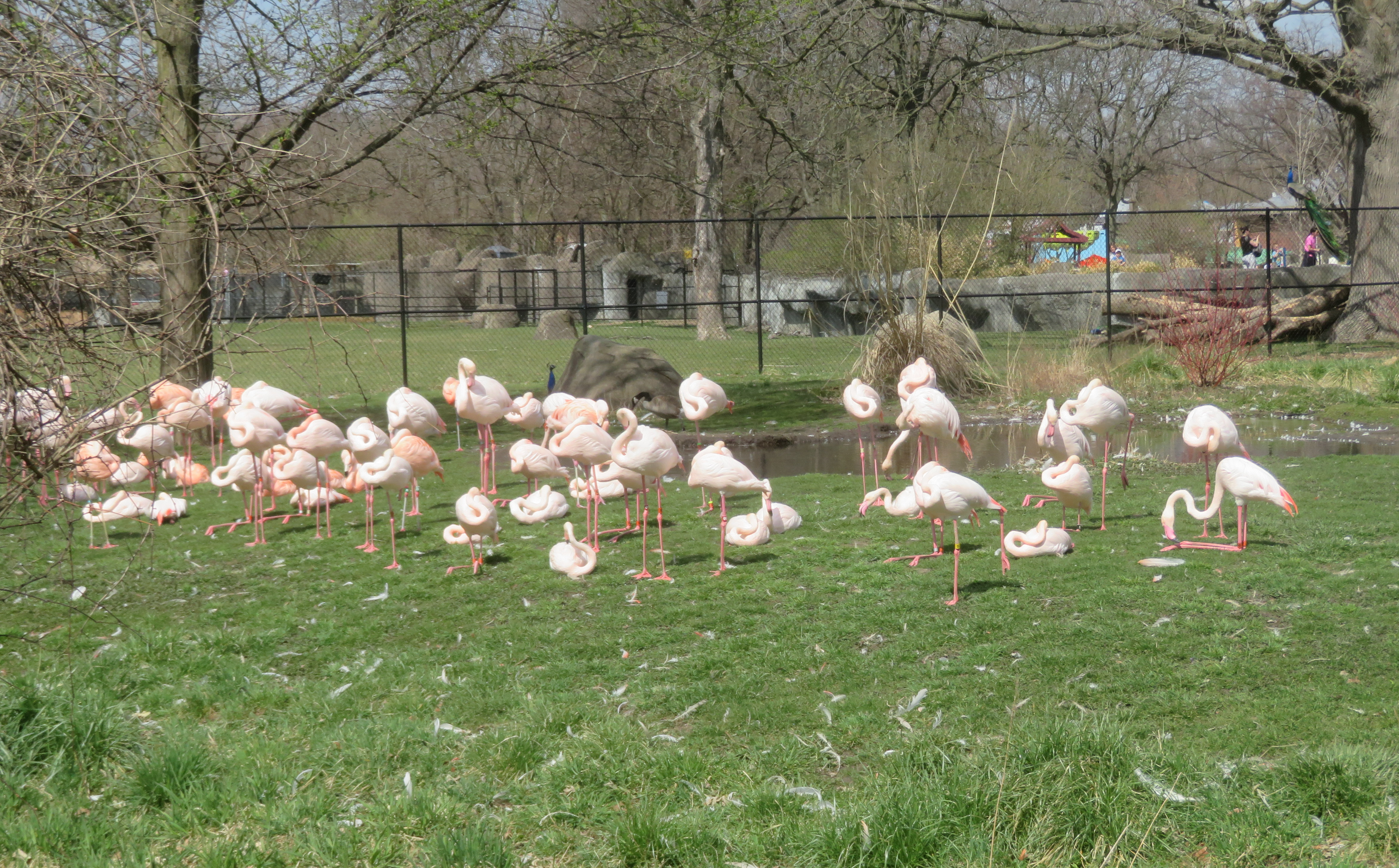
Across from this complex was a large, green habitat where in two species of Flamingo resided.  It's seemed an impossibly large space for the needs of this species and left me wondering what sort of hoof stock (antelope or gazelle) might have once lived there.  The flock is actually made up of two species of Flamingo who would never meet in the wild.  The Greater Flamingo calls central Africa home, which the Chilean Flamingo (as the name suggests) calls the Western slopes, valleys and fjords of Chile home.  On our way we passed a volunteer that we'd seen at least twice before.  I sort of figured out that her role was to walk laps...

The entrance and exit to the Harambe Great Ape House.

The Interior Western Lowland Gorilla Room


Western Lowland Gorilla
Gorilla g. gorilla

Mshindi, the troop's silverback male.


The interior space used by the Chimpanzees.

Common Chimpanzee
Pan troglodytes

Here Tanya (31) makes her was to the window with 10 month-old Tai holding on to her back.

Most of the Chimp's were napping around in nests made from blankets and towels.  But the younger ones were up and about.  I believe this is Jane (6).

The zoo is home to a mixed species flock.
Chilean Flamingo
Phoenicopterus chilensis
&
Greater Flamingo
Phoenicopterus roseus