Saturday, December 31, 2022

Birds of Winter


White-throated Sparrow

Dark Eyed junco

National Gallery of Art: Sargent in Spain

Today was a cool-musty, damp, gray day in the DMV.  The sort of day that is really easy to waste!  And the thought crossed my mind--but then so did "Sargent in Spain" at the National Gallery of Art.  The exhibit closes on Monday, and Monday being the last day of my winter seemed like a better day to just do nothing!

John Singer Sargent is, perhaps, my favorite artist of all--and certainly when I am in the midst of his art, the others take a back seat. What do you get from him?  Technique?  Unassailable!  It doesn't matter the medium.  Pencil/charcoals?  Check,  Oils?  Check.  Watercolor? Check!  Once he set to preserve an image to paper/canvas, the result was so imbued with life--that you cannot but stand in awe of it.  I have never seen the smallest of sketches that did not speak volumes of Sargent's craft, insight, and love.  I am convinced, that as easily as you or I breath the air, John Singer Sargent loved everything that he immortalized with his art.

The exhibition "Sargent in Spain" covers a handful of trips that he took there, a small representation of the images that he created there, and the influence of those trips and works on his final opus: The Public Library in Boston, Massachusetts.  Sargent toured Spain three times in the late 1800's and again in 1903, 1908/09, and finally in 1912.


The Exhibit opens with a room dedicated to his studies of masterworks he had encountered at the Prada Museum in Madrid during a visit there in 1879.  He would have been 23/24 at the time.  Studying paintings made over 200 years prior, he placed his own, decidedly modern take on the subjects.  The Painting of Juan Bautista Martinez del Mazo (1638-1683) of the child Margarita became an amalgamation of that work and the more famous "Las Meninas" by Diego Velázquez (1599-1660), Martinez del Mazo's father-in-law.  Like all of the works in this introductory gallery, Sargent's budding genius is on display.

Sargent painted "The Infanta Margarita" after Juan Bautista Martinez del Mazo in 1879.

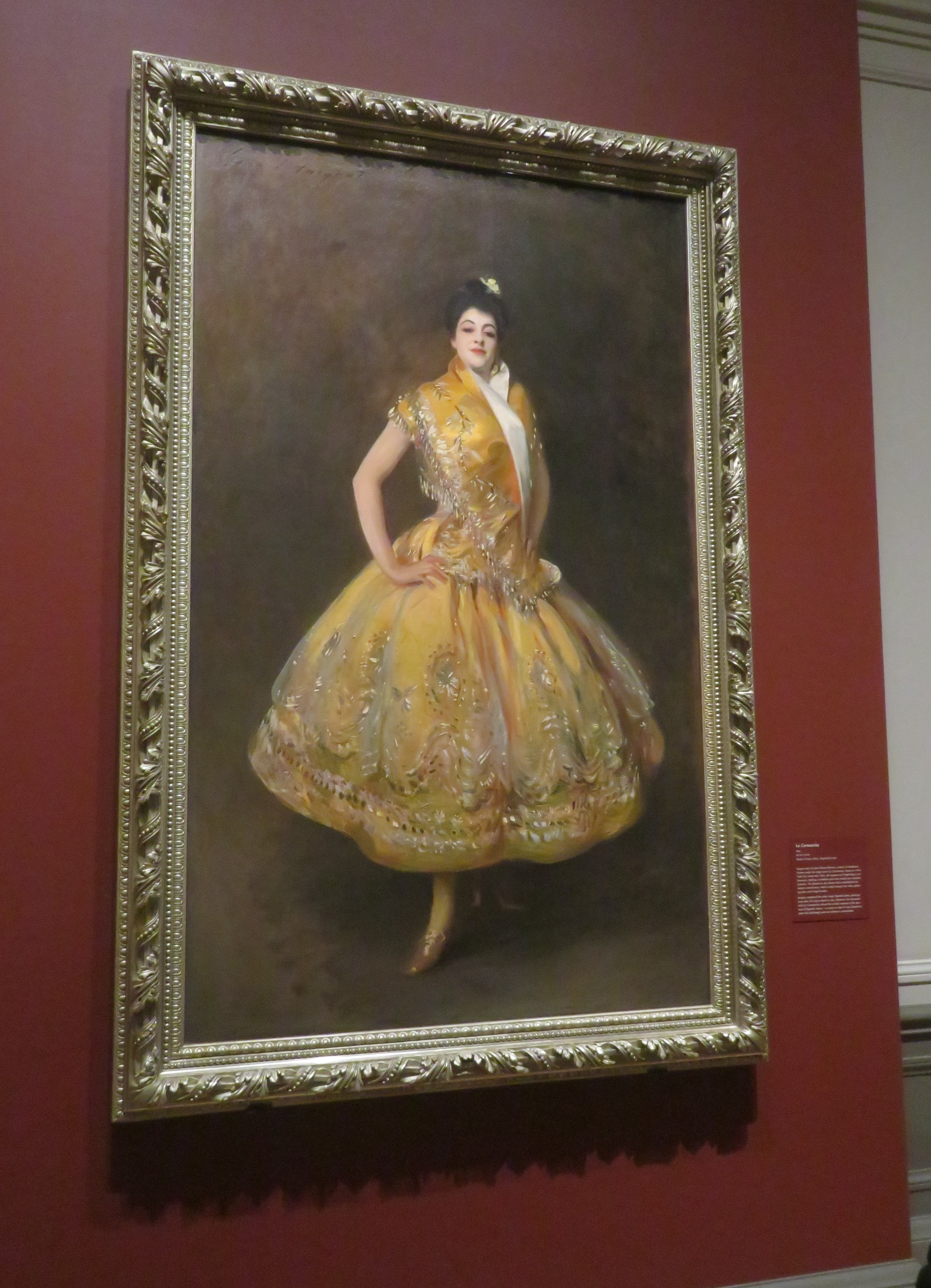
The next room featured a range of works around his fascination with Flamenco dancing and the 19th-century master, Carmencita.  She is the inspiration for a handful of large scale paintings, including the iconic "El Jaleo"--a centerpiece of the collections of the Isabella Stuart Gardner Museum in Boston.  The original was not part of the exhibition; yet several sketches and "studies" for the work were.  And perhaps most interesting of all was the inclusion of a short film of Carmencita dancing from the Thomas Alva Edison early film collection in the Library of Congress.  She is actually performing in the same yellow dress that Sargent painted her in.


Study for "El Jaleo"; Seated Musicians' Heads and Hands, 1881

"La Carmencita Dancing", 1890

Video Clip: "Carmencita" 1895
William K. L. Dickson (1860 - 1935)
& William Heise (1847-1910)
Thomas Alva Edison Collection, Library of Congress

"La Carmencita", 1890

Albert de Belleroche, circa 1882
Portrait of a Welsh-born painter wearing costume items John Singer Sargent bought in Spain.

The next couple of Galleries take up the subject of Sargent's fascination with and acumen in depicting architectural subjects.  These morph into images of people and animals in common unguarded moments.  Most of the works are executed with watercolor, but a good number are also painted with oils.  The watercolors open up for me the heart of my love of Sargent.  His intuition and ability to use a medium infamous for it's difficulty demonstrates more than anything else his genius.  Many watercolorist, my humble self included, incorporate the independence of the pigment pretending to have meant it to be that way all along!  Sargent does play this game. He understands what every brush strokes implies and offers them up with a confidence and abandon that becomes perfection.  I study his paintings and I think: he saw it there, and then used the brush and paint to reveal it to the rest of us!
"Escutcheon of Charles V of Spain," 1912

"Spanish Fountain," 1912
Another aspect of Sargent's genius: Light.  He brings truth to light in a way that exceeds the two-dimensional limits of his subjects.  It effects me to the point of tears.

"Turkey in a Courtyard," circa 1879-1880

"Sierra Nevada," 1912
Up close this oil painting was little more than a sloshing about of colors as thick as icing, but just a few feet away and a moment in time, one hundred and ten years past, is as fresh and alive as it must have been on this sunny day in Spain.

"Spanish Soldiers," 1903

One of three works on this theme in the exhibition, depicting soldiers convalescing at the Royal Hospital in Santiago de Campestela.  Three paintings representing dozens that Sargent made as a result of this visit.  The watercolor highlights two aspects of Sargent's work.  1) his prolific output.  Sargent made paintings of his experiences like I take photographs!--well, at least, GOOD photographs.  And 2), his sensual side.  I mean, who are we kidding her, his recovering soldier is sexy!  As was La Carmencita, the flamenco dancer.  Sargent was in his heart as bi-sexual as any person could be without the label having been created.  He is famous, in his lifetime infamous, for two portraits.  Madame X--so scandalous that she wasn't named, and Dr. Pozzi--a man dressed a red robe looking like he's ready to remove it.  And I full-well love him for both.  

"Women at Work," 1912
3) his understanding of light.  Sargent knew the power of contract like few artists then or since.  He's a major inspiration to me.

"Driving in Spain," 1903
I would have taken a photograph.  Sargent paints a picture!

The next set of paintings focuses on his visit to the Spanish Island of Majorca.  Today, home to uber rich jet-setters, but in 1908, a backwater with orchards and fishermen.
"Majorcan Fisherman," 1908


"Pomegranates, Majorca," 1908

In the final gallery, we treated to images form Sargent's final and perhaps most intense, ouvre: the Public Library of Boston.  A shrine to humanism, the images connect the dots between what Sargent created for this iconic public space and his experiences in Spain.  It's an ambitious drawing, but also fascinating and well researched.

"Tarragone," 1908

"St. Teresa of Avila," circa 1909
Created from a post visit sketch, a watercolor sketch of its own right.  Would that I could have watched him conjure up this image from his notes and memory!


Christmas Tree @ the Canadian Embassy, Washington, DC

The Embassy of Canada is the only Embassy to be located on The National Mall in Washington, DC.  Britain may brag about our "special" relationship.  Mexico may share the most talked about land-boarder in the world.  But only Canada's Ambassador can look out of his office window and see the U.S. Capitol, or walk across the street and have lunch at the National Gallery of Art.


Friday, December 30, 2022

Baltimore Museum of Art: Derrel Ellis -- Regeneration

What a beautiful and poignant introduction to an artist whose life ended way too soon.  Ellis grew up in a home with a father who was an accomplished professional photographer.  He was well versed in the art of composition, contrast and emphasis.  Principles of design that no doubt informed his own personhood growing up gay in a home and a place when being homosexual meant being an outsider among outsiders.  In the exhibit, there's a place that speaks to the importance of his friends, of the family he created in place of the one he lost. Ellis died in 1992 of AIDS at the age of 33.  This is his first comprehensive exhibition.  


untitled (Couple Embracing)
c. 1980-1983
Watercolor and black roller ball pen on paper

untitled (Friends)
circa 1990
Brush and black ink, wash, and graphite on paper


untitled (Grandmother Lilian Ellis)
circa 1981-1985
Brush and black ink, wash, and graphite on paper


Self-Portrait after photograph by Robert Mapplethorpe
1989
Brush and black ink and wash on paper

Baltimore Museum of Art: Omar Ba -- Political Animals

 One of the greatest things about the Baltimore Museum of Art is how it embraces its mission of bringing a full range of international and national contemporary artists to the public's attention.  Currently the works of Omar Ba and Darrell Ellis are featured in focus exhibitions.  

Ba is a Senegalese painter whose works reflect a limited palate and an intricate, intimate and engaging compositional style.  Many works at first glance appear to have elements of tatted lace and embroidery work suggesting the idea of quilting, of assemblage of repurposed components, a constructed community, a redemption.  When you read about the author's life and inspirations, you recognize aspects within the works reflecting the contemporary realities and controversies of life in a modern west African city like Dakar--issues inextricably tied to the larger world of international greed, exploitation and political power.  A corrupt and unjust world.  And yet, I was drawn to the tenderness and universal humanity expressed in the figures Ba nearly always builds this paintings around.  It seemed to suggest the resilience of the people, their ability to retain their dignity and transcend these circumstances beyond their control.  Like the proverbial onion, the more you peel one of Ba's paintings, the more you discover to wonder at.  

This is Ba's first solo exhibition at a major American Art Museum, it is hard to imagine that it will be his last.  These 15 works will be on exhibit into April of 2023.  


Compartment-aller simple 3 (One-Way Trip #3), 2022
Oil, acrylic, colored pencil, gel pen and white correction fluid on canvas


Thursday, December 29, 2022

Baltimore Museum of Art: Coming Attractions: The John Waters' Collection

Visited the Baltimore Museum of Art today with friends.  One of the impetuses was a recent visit they had made from which my friend spoke of this special exhibition.  "Coming Attractions: The John Waters' Collection" is not only a tongue in cheek nod to the Baltimore icon's work in cinema, but a reminder that the works have all been bequeathed to the BMA upon his death.  

Among the works presented, the motif of the phallus is rather ... present...dominant...evident, swelling, throbbing, LARGE! throughout the works.  Once you see it, and it does not take a genius to see it!  You see it everywhere!  From something as pedestrian and innocuous as a coat hook, to the facile column of a child's stuffed toy.  As one of my friends agreed during a discussion of this, "The man loves his penises."

But what I loved most of all was that, works by artists like Andy Warhol and Peter Hujar notwithstanding, the collection features artists of little note in the wider world.  This brilliant artist in his right, chose works that he found delightful regardless of what anyone else thought of them.  And in time, the entirety of the collection tells a story that became immensely valuable.  Interestingly enough, the Baltimore Museum of Art has a track record of this sort of thing.  Their entire modern art wing is predicated on the collection of the Cone Sisters, who amassed a group of over 3,000 post impressionists European works when no one thought artists like Matisse and Gauguin would actually amount to much.

From the exhibit, "Coming Attractions: The John Waters Collection," selected works.

"Outtake from Nostalgic Depiction of the Innocence of Childhood," 1990
Mike Kelley


"Pink Thing," 2010
Brett Reichman

[I missed the appellation of this work...]
It reminded me of Kukla, from the seminal Chicago children's puppet show, "Kulka, Fran and Ollie".  I can't help by imagine the Mr. Waters also saw that as a child.  Who knows?  Art--it just connects dots of meaning when it's any good.