Tuesday, November 8, 2022

Turtle Back Zoo: African Adventure

 From the looks of things, this area of the zoo has seen some of the most recent renova- tions.  There are basically three areas: 1) A huge double habitat home to African Lions and Spotted Hyenas (although the species of Hyena is never stated anywhere.), 2 an enclosed African Penguin colony shared by a pair of pink-backed pelicans, and 3) a Savannah area with multiple habitat areas for Masai Giraffe, Ostriches and "Antelope," which presently refers to a single male Bontebok.

AFRICAN LION/SPOTTED HYENA


The Lion Habitat is very impressive, one of the largest I've ever seen outside of a wildlife park.  Unfortunately the Lions were not taking advantage of it or the unseasonably warm (upper 70's) temperatures.  The zoo also has three Spotted Hyenas.  Two females and a male.  The male only recently arrived and is still in the process of being introduced to the females.  The trio is part of a breeding recommendation through the AZA and its SSP's (Species Survival Programs).  With the enormous area available to the Lions, it is hard not to imagine that Turtle Back is equipped to manage African Lion breeding, too.  

In the second habitat was the male Spotted Hyena.  He was sleeping next to the observation alcove and could be easily observed and admired.  At one point he deigned to wake and look about before returning to his dreams.

The entrance to the African Lion & Spotted Hyena Habitats

Viewing alcove for one of the two habitat spaces

Spotted Hyena male


THE SHORES OF AFRICA

The building that housed the African Penguin colony and Pink-backed Pelicans was designed to look like a traditional southern African abode--and I must admit, like American Indian Tepees, the only place in Africa where I saw anything like this was at Victoria Falls in Zimbabwe where it was part of a "Traditional African Village" tourist experience.  Inside there is one large habitat that fills the place like a peninsula to create a "C" shape area for visitors to observe the birds from three sides.  Each side has a huge glass barrier with under water viewing, and the land area is itself a peninsula.  Above the habitat area sky lights offer some natural light.  


At the time of my visit there were two Pink-backed Pelicans sitting on the faux rocks, and three African Penguins.  There didn't appear to be any opening between the habitat and off exhibit holding areas, but honestly, there is no way that they could only have a colony of 3 birds.  The area was nice, better than many I have seen, but a shadow of we have at the Maryland Zoo.  I inevitably leave other zoo's exhibits of African Penguins (or any penguins for that matter) feeling sorry for the birds.  I could not see where there was any outside habitat space, but it might just be that it was closed off and not in use because of the Avian Flu.  It would seem like a huge error to not have created exterior habitat space, too.

The Shores of Africa: Penguin & Pelican Building


The central viewing window with digital information displays

AFRICAN SAVANNAH

The largest building at the zoo is the Giraffe House--it is humongous.  The giraffe standing next to it was dwarfed by comparison.  The areas for the giraffes is also very large with additional habitats on the far end of the main space, no doubt to allow for separation of the bull from the cows and possible new mom calf alone time.  It seems clear that the place is set up for breeding, too.  The species of giraffe at the zoo is the Masai, and low, what's this?  The signage indicates it.  Within the largest habitat guests are encouraged to appreciate the mix of species described as Giraffe, Ostriches and Antelope.  The ostriches were not out (Avian Flu thingy again), and the antelope was a sole male Bontebok.  A handsome little cus.  I've never seen one before in the flesh.  I asked a keeper about it and she basically said that their female had passed and that future of this little guy was in question.  Either they would receive suitable breeding partner/s OR he would be relocated to breed.  If the later happened, they were set up to receive replacements from whatever species was deem compatible with the Giraffe and ostriches.

The Giraffe House

Giraffe feeding station


Bontebok


Handsome fellow!


Turtle Back Zoo: Amazing Asia!

 Well, you could certainly see the potential for amaze- ment!  Unfortu- nately, on this visit, it would better be called Disappointing Asia...  And that OKAY.  That's, to me, actually the sign of a good zoo.  Animals have options, they decide when and where they want to hang out.  So what was there that wasn't there?  The back side of this area houses two large habitats.  One for Amur Leopards (the most critically endangered off all the big cats with any hope of being saved) and the other for Snow Leopards. I really admired the habitats, 'cause there were no inhabitants to be seen.  The other component is a building that has a series of habitats attached to it.  Two are open large cage sorts, one for a Clouded Leopard and the other for a Red Panda.  Between them are two other habitats, one two stories tall with huge glass barriers.  The larger one had a least one large Hornbill of undetermined species, and the other a large tortoise of some species.  Again, neither are mentioned on the zoo's website.  

The glare on the glass made viewing either the bird or tortoise next to impossible.  Signage did actually mention of a Slow Loris, but it was no where to be seen, and it wasn't exactly clear where it was located, maybe with the Red Panda?  Across from this another habitat was home to a trio of White-faced Gibbons, and they were attached to a building that was home to a Komodo Dragon that was off exhibit and the building was closed as were pathways nearby for the aforementioned Press Conference.  Another curiosity of this zoo, it is the only one I have ever visited where large signage celebrating new exhibits and future upgrades also can a larger than life image of the zoo's CEO and Director.  He must be a Republican! <--that's a joke, BTW.


The final part was the White-faced Gibbon Habitat.  It was unclear to me whether or not the scaffolding was an intentional part of the "design" or a serendipitous afterthought as the result of some past painting of the columns project.  It was clear that the gibbons appreciated the extra climbing opportunities.

The entrance with the Amur Leopard habitat behind.

Clouded Leopard Habitat

Look way up to see the sleepy Clouded Leopard

Clouded Leopards have such distinctive markings.

Red Panda Habitat


White-Faced Gibbon Habitat


Turtle Back Zoo: Farm, Australia Walk-about and Ambassador Animals

 The center of the zoo is home to a large barn with farm animals and goat petting.  There is also a side barn with ponies for riding.  Pressed up against this is an Australian walk-about, but your can't because it's closed due to the Avian Flu presently killing songbirds all across North America.  Across from this area are a series of habitats for some of the zoo's ambassador animals.  Some of this was closed off for the use of the zoo's CEO who was giving a press conference to announce the next renovation project at the zoo.

FARM YARD ANIMALS


Within the barn are goats, kune kune pigs, an American Donkey, a horse of indistinct breed, some chickens, likewise unidentified, the promise of an alpaca, but no one en casa.

There are 4 species of goat, this is an Anglo-Nubian, I think.  They also had West African Dwarf, Toggenburg, and another I don't recall.  Unfortunately, the animals listed on their website is quite incomplete.

Jacob's Sheep
The Pony Ride Barn

AUSTRALIA

The anchor to this area is the Budgie encounter which was closed to the public.  If it were open, I could have also had much better views of the pod of wallabies.  I could not find a sign that identified their species, but there was a large group, maybe 7 or 8 animals in a very large space.  
Sculpture of a child holding up a bird at the entrance of the Budgie Encounter.


The Wallaby Habitat

ANIMAL AMBASSADORS

Much of this area was closed, but a very nice Cheetah Habitat was viewable from the long pathway on the lower side of the Farm/Australia areas.  The Habitat was nicely deep, and impressively wide to allow the Cheetah to sprint.  The docent explained how it had been home to a trio of sibling (1 female and 2 males); however, when they reach maturity, the males had been moved.  Now, the female cheetah lives with a companion dog, a golden retriever.  I've seen the same exact set up at the Richmond Metro Zoo in Virginia.  These species seem to make excellent companions.


I Voted!

One of the sacred things I do. Get up. Get dressed. Walk over to the community center just outside of my neighborhood. VOTE with my neighbors.

Home and time to make a breakfast worthy of enfranchisement.  Romeo can't vote, but he does enjoy a mite or two from such a hearty plate!


Monday, November 7, 2022

Turtle Back Zoo: North American Speies

 Not exactly knowing how to proceed upon entering the Turtle Back Zoo, I found the nearest restroom!  I'd been driving for over 3.5 hours and I needed to pee.  At the risk of TMI, I'm of an age were managing the old #1, isn't always done from the standing position with a bladder fully loaded.  Don't laugh young men...your day will come!   Using the opportunity to study the zoo map proved unhelpful.  So, upon finishing my business, I just headed to the right...kinda like our nation...

As fate would have it, this led me into a series of habitats that I would call Animals of North America.

BLACK-TAILED PRAIRIE DOGS

The habitat was spacious and fun.  Little folk could enter a tunnel and pop up in orbs at prairie dog eye-level.  A common conceit at many zoos.  I wasn't clear on the giant sunflowers...a nod to South Dakota?


NORTH AMERICAN BLACK BEAR

Has an amazing habitat.  Was not out to be seen...

AMERICAN BISON

A nice space that is home to three from what I could tell.  A magnificent bull and a pair of cows.  It was not easy to see any of them because of their choice of being within the habitat.  You can't fault animals for their choices, and kudos to zoos that have rich enough habitats to provide options.

The beautiful bull

BIRDS OF PREY

Above the Bison is a loop of habitats devoted to large birds: American Eagle, Cooper's Hawk, Harris Hawk and Raven.  The Eagle and Raven were off exhibit because of the Avian Flu epidemic, and the Hawks were there, but not easy to see, a common problem at zoos with Hawks.
Generous American Eagle habitat, without an Eagle.

Raptor Row: home to Hawks and Ravens.

My best photo of the Cooper's Hawk

GREY WOLVES
The habitat was amazing.  Lots of space, a flowing stream, a den with public viewing.  Also a Docent to ask questions of!  The zoo is home to three Grey Wolf female siblings.  They are rather on in years, so no surprise that they were all sleeping.  She also told the origin story of the zoo's name.  Apparently there is a bolder in a stream nearby that is huge and resembles a Turtle Shell.  It is reverenced by the Lanape Native Americans and from there became the name of the zoo.

BIG CAT COUNTRY

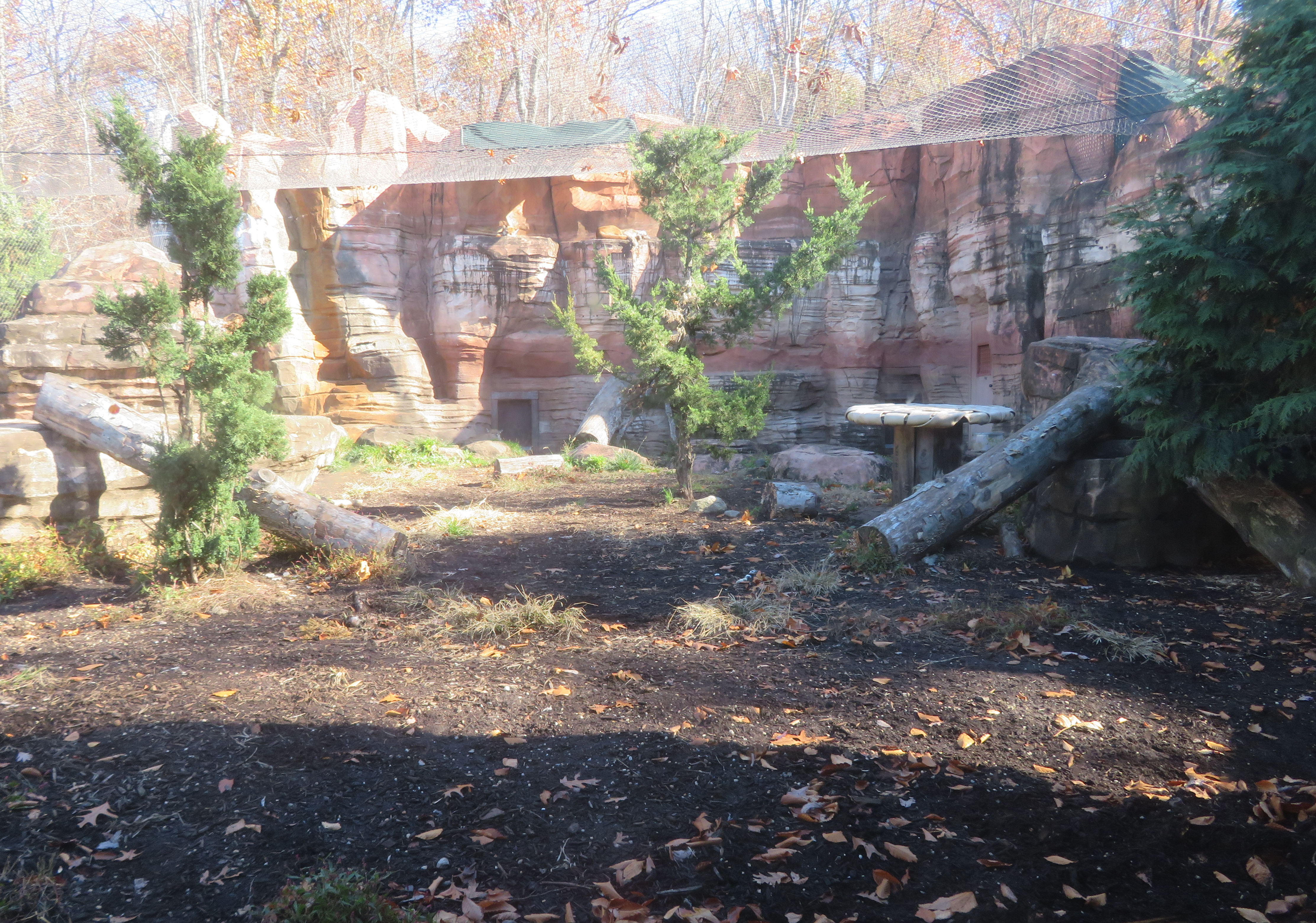
The top of the hill is home to two large felines: Pumas and Jaguars.  The habitats are side-by-side and feature large, scalable rock features with perches to sleep a lazy unseasonably warm Monday away on.

MOUNTAIN LIONS (PUMA)
Mountain Lion habitat

Mountain Lion #1...hanging out below near the door to the behind habitat spaces.  Not looking very happy. 

Mountain Lion #2 curl snoozing

Mountain Lion #3 Lazy sleeping!

JAGUAR
Jaguar Habitat

Another sleepy kitty!