Showing posts with label National Museum of the American Indian. Show all posts

Sunday, August 6, 2023

Museum of the American Indian: Robert Houle Retrospective, part 4

 The exhibition ends with more works inspired by poetry.  A series of smaller monochromatic drawings accompanied by the poetry of Gerald Vizenor.

tiny red spider
marches over the cascades
mountain map

flights of starlings
curve and shimmer wing to wing
sunset sway

white birch
moody shadows in the snow
grave houses

mighty crows
bounce over the great river
slippery stones


Museum of the American Indian: Robert Houle Retrospective, part 3

Another section features more resent works that center around Houle's experiences at the Sandy Bay Indian Residential School I.  One group of works are black and white images that are figurative in nature and spectral. 

Dark Moses, 2009
Oil on Paper
Robert Houle, 1947

Another gallery is dedicated to a group of smaller works is subtitled: "schoolhouse, praying, sleeping, waiting, people, lake."


Saturday, August 5, 2023

Museum of the American Indian: Robert Houle Retrospective, part 2

One aspect of the exhibition explores a collaboration with with the poet and personal friend, Brenda Grushko.  Houle used this opportunity to explore both abstract expressionism via geometrics, while striving to make an emotional connection to the poems through his art.  

Epigram: The Shortest Distance, 1972

Coming together
                         is a very slow process
               when you're on

   parallel
lines.

~ Brenda Grushko, 
from "Moments Out of Time"


Parallel Lines, 1972

        Let's you and I
            be different
and seem 
           indifferent
    when we say

"goodbye."

~ Brenda Grushko, 
from "Moments Out of Time"

Museum of the American Indian: Robert Houle Retrospective, part 1

One of the first pieces that you encounter in the exhibit is an instillation.  Along with a nearby video animation, the piece was inspired by one of the forgotten encounters between indigenous people of the Americas and Europeans.  Between 1845 and 1848 a small group of 11 members of the Mississauga Anishinaabeg people of Ontario toured the major cities of Europe like Paris performing cultural dances, etc.  In the course of the tour 6 members of the group contracted small pox and died including the leader's wife and three children.  The piece "Paris/Ojibwa" depicts a Parisian salon with four figures: Shaman, Warrior, Dancer, and Healer on panels on the walls.  Each looks away from the room to a distant homeland, while ornately represented in the wainscoting below are images of the small pox virus. 
A Daguerreotype c. 1846 of members of the group attributed to the painter, George Catlin, whose career was made on the production of portraits and scenes of indigenous peoples accompanies the wall text.


Museum of the American Indian: Robert Houle Retrospective, Introduction

 One or the current exhibitions at the Museum of the American Indian in Washington, DC is a retrospective of the work of Saulteaux First Nations artist, Robert Houle.  Born in 1947 in Wiinepeg, Canada, and subjected as a youngster to the indignities of the Catholic boarding schools, but buffered by a strong family and community support network, his works reflect the tension created by the misappropriations and other influences of the Settler Culture on the traditional Saulteaux and other native societies.  A quote featured earlier on the catalog from Robert's mother Gladys sets the stage, "If you are going to be an artist, paint only what you know."

The exhibition opens outside of the formal gallery spaces with a pairing of one of his monumental works from 1992, Kanata.  The presentation is a pairing of two paintings.  One, and reinterpretation of the Benjamin West's 1770 masterwork "The Death of General Wolfe" that hangs in The National Gallery of Canada in Ottawa.  The second features the Native American in the composition in a setting devoid of war and the presence of Europeans.  Even in the first painting the original work by West is reproduced in sepia tones saves for the image of the Native American.  

The work is large and draws one into its presence.  And I thought, where can Houle take me from here?


Monday, February 18, 2019

National Museum of the American Indian, Our Universe

Once at the National Museum of the American Indian, I was also delighted to discover another exhibit that I had not seen called "Our Universes".  The exhibit features 12 nations from across the Americas views on spirituality.  Each group is given a gallery and the design is parallel across each. 

  • A simple icon representing the name of the nation with the name
  • A photographic image with a brief explanation of the spiritual beliefs
  • A corridor leading to an inner gallery
  • At the inside entrance of the corridor a photo gallery of the citizen curators from the nation who assembled the artifacts, images and words
  • More text and images along the corridor
  • An inner gallery filled with artifacts and images and often audio describing practices, explaining artifacts, and/or telling personal narratives related to the topic.
  • Some also included video presentations
This, too, could easily become a course of study in Native American Spirituality.
Examples of the Overview panels at the entrances to the peoples specific galleries


One of the Citizen Curators Gallery walls.

An example of the types of artifacts found within the inner galleries.

National Museum of the American Indian: The Americans

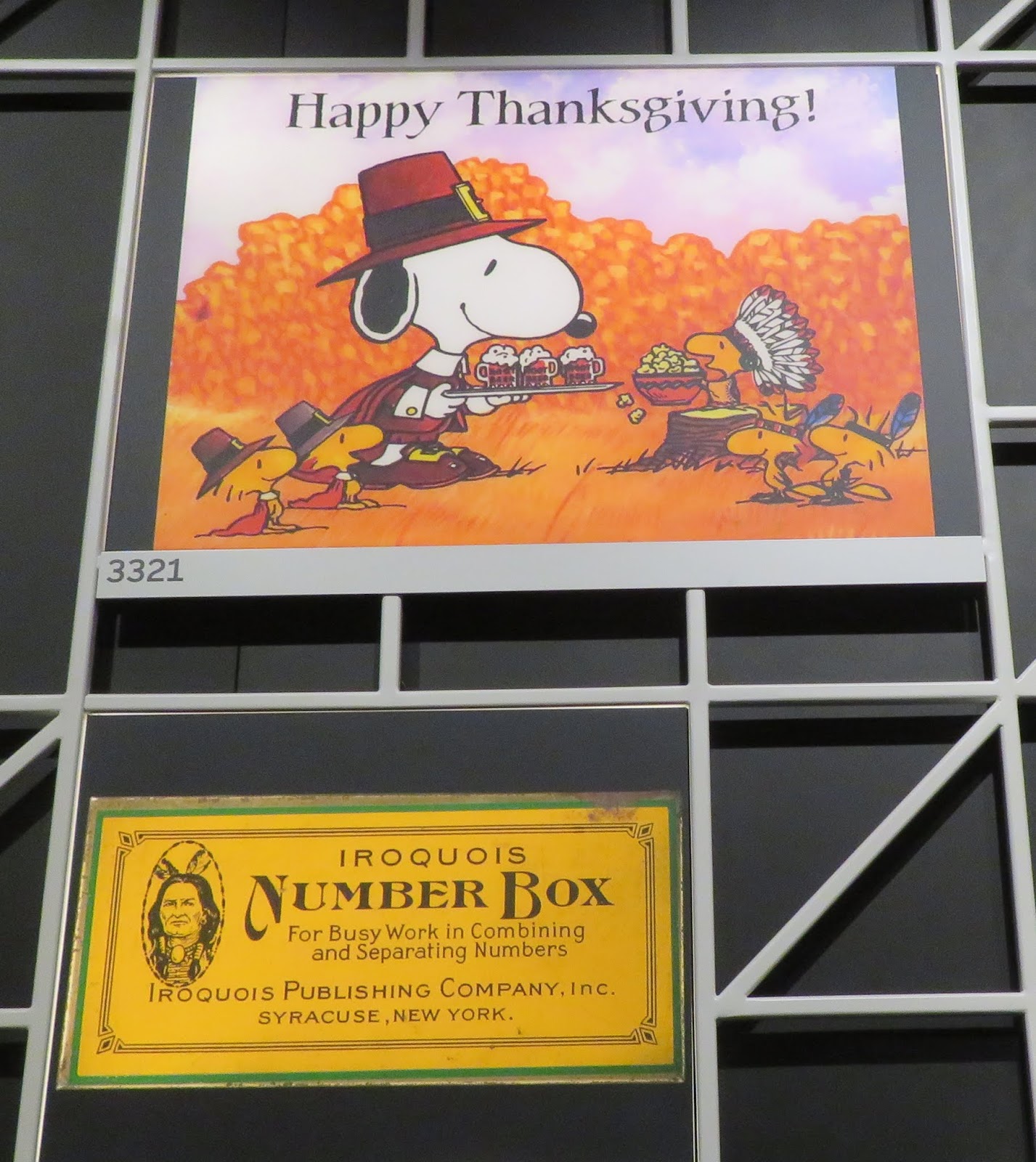
One of the reasons that I had the National Museum of the American Indian on my agenda was a new exhibit just opened called "The Americans".  It is a broad exploration of the ways in which Native American images and ideas have been co-opted by the dominant Eurocentric culture of the United States.  And then a closer look at 4 iconic moments in United States history centered on encounters with American Indians: 1) Thanksgiving, 2) Pocahontas, 3) The Trail of Tears, and 4) The Battle of Little Bighorn.  This ought to be distilled into a required course in American History in all High Schools.
 You enter into a large hall covered in images and artifacts representing the ways in which the dominant culture as used American Indian themes in particular, but not exclusively, to obtain economic advantage.  It is a sobering phalanx of witness to injustice. 


On either side of the hall are two galleries where the aforementioned particular moments are further examined.  Images from two of the four.

POCAHONTAS

This gallery focused on the way we think about the life of Pocahontas contrasting the historical record against such appropriations of her life as theatrical reenactments and the recent Disney feature length cartoon.


The TRAIL of TEARS

A major aspect of the design of this gallery was a series of diptychs aligned like the cantilevered bellows of an accordian featuring some of the major voices from the time starting with Thomas Jefferson and stopping with Andrew Jackson.