Showing posts with label Erie Zoo. Show all posts

Wednesday, July 9, 2025

Erie Zoo: All Aboard!

 The Erie Zoo has a track-based Railway Ride.  The experience takes guests around the northern rim of the zoo and then off into the park beyond to the east before turning around and coming back to the zoo.  It also has a really interesting little O-gauge model train mini-habitat in the very heart of the zoo.  It's not well advertised.  I just sort of stumbled upon it as I was fixing to leave.  It's also not terribly well maintained.  It was running, but it felt like a real afterthought to anything else.  Like whomever is responsible for its upkeep either had better things to do, or hadn't been around for weeks.  Still, a model train will always capture something in the imaginations of children no matter how old we are!  You can find it in the zone marked [Ee].
An image of the creek that divides the zoo.  Given the current climate mayhem, it isn't impossible to imagine how it could become a raging torrent over-flowing its banks and devastating a little zoo like this.  We live in provocative and interesting times.

The Erie Zoo train crossing an adjacent bridge.

The O-scale Model

A contrivance dedicated to William D. Kinney.


And either neglected in the most ridiculous simple ways, or ridiculous staged as in a Monty Python killer Rabbit has just slaughtered a cow, a horse, and a pig to the horror of the devestated farmer.  And now has chased a rooster into the bed of pick-up in a vain attempt to survive the psychotic bunny's killing spree.

Just say'n...  The imagination abhors a vacuum.


Erie Zoo: The Pixie Children's Zoo Side

 Across the creek, the Erie Zoo continues with a lot of younger children centric activities.  Chief among these is a Carousel, but there are over playgrounds and a maze-like mountain climbing space.  Interspersed are other habitats.  These include: 1) a Llama/Alpaca herd, 2) a Kangaroo walk-through zone, 3) an American Alligator habitat, 4) a colony of a dozen or so African Black-footed Penguins, 5) Lorikeets, and 6) Giant Tortoises.

This is zone [Dd], come and see!

One of two bridges used to cross the creek.  The hanging baskets full of flowers are emblematic of the wonderful flora found all around the zoo.

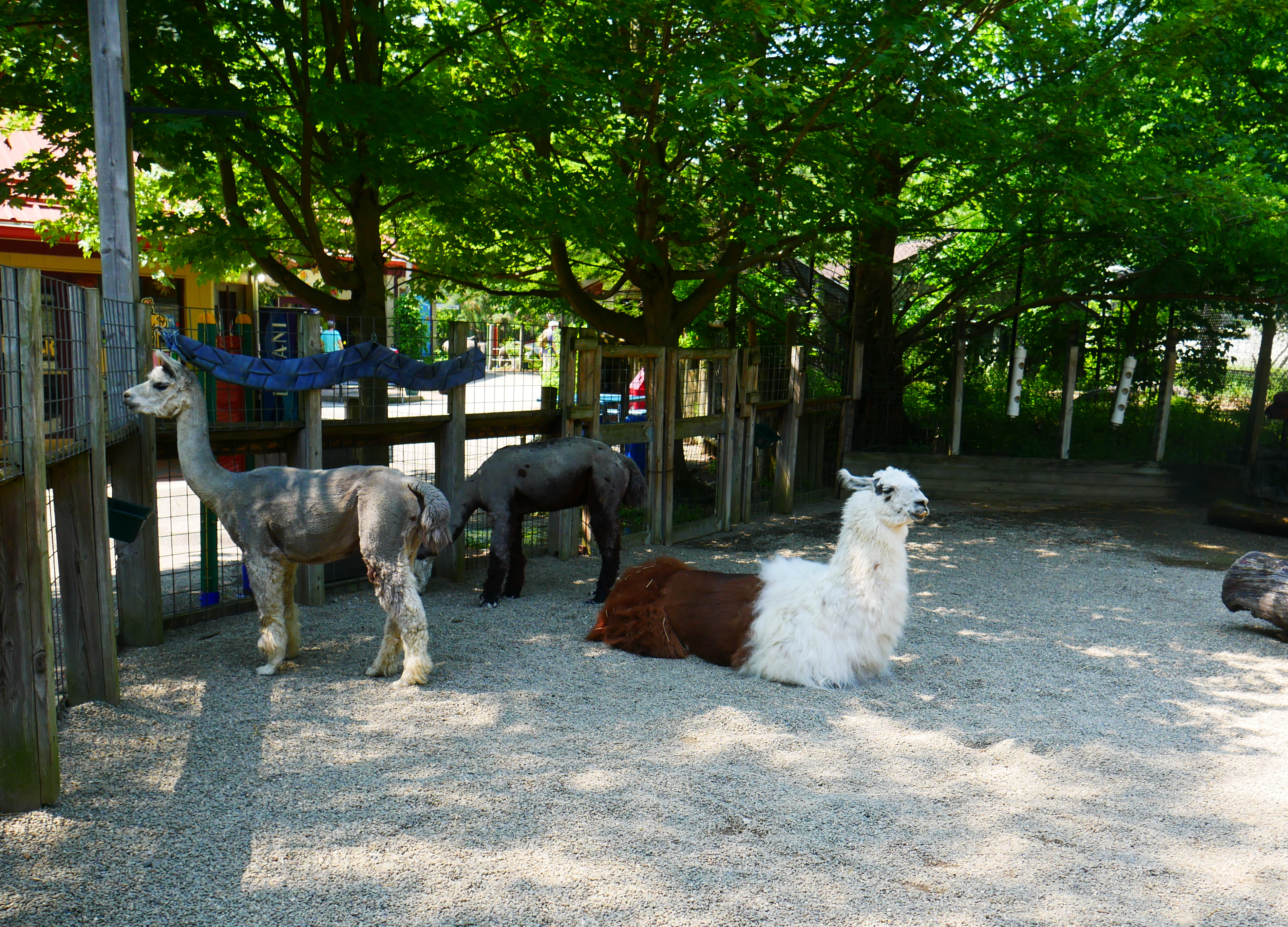
The paddock with both Alpaca and Llama

LLAMA
Lama glama

A walk-through habitat with Kangaroos and Wallabies.  Two zoo staff were also located here to help keep the rules.  When I asked one which species of Kangaroo and Wallaby were present, she didn't know.  She said, "I'm sure there are signs somewhere."  I couldn't find them.  Later I learned that there were Eastern Grey Kangaroos (which I suspected, but thought the roos present were so small), and Bennett's Wallaby's.

A second staff member knew that the Kangaroos were all two-year-olds.  This explained the size conundrum.

She also explained how the only male was the newest member of the pod.  Apparently, he's been bullied by the females.  A got to witness an example of this social interaction.  He wasn't injured in any way, but clearly he's discovering his place in the pecking order.

EASTERN GREY KANGAROO
Macropus giganteus

AMERICAN ALLIGATOR
Alligator mississippiensis

AFRICAN BLACK-FOOTED PENGUIN
Spheniscus demersus

The African Penguin habitat consisted of both an interior area visible through a large glass window, and an exterior place with grass and a nice water feature to swim in.  Would I give this arrangement a grade it would not accede a "C".  Possibly even less; however, I have seen and spent years enjoying the best habitat for this species in North America, so comparisons are hardly fair.

All the penguins were inside except for this mature female.  I found this to be very curious until I realized she was on a mission.

I watched her until she found a piece of branch that she snapped up and headed back inside with it.  Another block in the NEST she was constructing.

Erie Zoo: The Rest Of The South Bank

 A "river/stream" subdivides the Erie Zoo into two parts.  The southern and western portion is the larger of the two, and once you've visited the previous two areas of the zoo, you've pretty much got the southern walkways left to do.  This is an area with habitats for some of the larger animals at the zoo, the Amur Leopard, the Amur Tiger, the Southern White Rhinoceros.  None of which were out.  And without a map and depending on the signage alone, I missed the pathway to the Zebra.  So what did I see?  

I saw the Warthog--I love Warthogs and this one had the coolest fucking hairdo I've ever seen!  I ascended the Tower and got some nice big views, just not of the Rhino...  I saw the African Wild Dogs, but with the chain link fence between us, no good photo ops.  I saw both the Allen's Swamp Monkeys and the Lessor Spot-nosed Guenon.  Both mid-sized arboreal monkeys native to Equitoral regions of Africa.  In all cases, the habitats were well proportioned--the Rhino could have benefited from more space.  But the structure with both exterior and interior habitats for the monkeys was exceptional. 

And you know, I mention the missing "A-list" animals, but honestly every animal is on my A-list.  So let's get to it, some pics from the zone marked [Cc]!


This part of the zoo has a rather obvious entrance.  To the right of it is the area designated for a possible future habitat for Andean Bears.  

COMMON WARTHOG
Phacochoerus africanus

I think this Rubble, but I'm not completely sure on that one.  And yet--have you ever seen a funkier do on a Warthog?

Where the Southern White Rhinoceros "Bill" might have been!

This events patio would become a sit-down eatery in the scheme presented by the 2019 Master Plan.

The Guenon and Swamp Monkey habitat, its expansive exterior space against the holding building with a nearly equally as large interior habitat.  

LESSER SPOT-NOSED GUENON
Cercopithecus petaurista


I hung around here for quite a while.  Later a grown female came out.

She gave me the opportunity to capture her with the glory of her amazing tail in full view.  Old World monkeys vary from New World monkeys in a few ways, but none more significant than their tails.  New World monkeys have prehensile tails that they can grip with to the point of supporting their body weight.  Those native to Africa and Asia use their tails for balance alone.  The way she's holding her tail is to counter her center of gravity as she leans forward.  Animals are Fucking Amazing!


Erie Zoo: From Africa to Borneo

 The next area to explore is adjacent to the main building and abuts the relatively new African Lion habitat.  Completed just 7 years ago, it is home to a pair of female lions: Eva and Desta who are also biological sisters.  They are just 4 years old, entering their prime breeding years.  Their habitat also comes with a covered viewing area.  A nice place to catch a break on a sunny, hot day.

Right next to the Lions you are greeted by the ruins of a southeast Asian temple.  The attention to detail is delightful and besides being home to the zoo's pair of Bornean Orangutans, there are also a pair of Visayan Warty Pigs and the "in progress" creation of a new home for the zoo's Red Pandas.  The main habitat contains both extensive interior and exterior space to allow for options all year around.  Although the zoo does close to the public from December 1 through February 28/29 each year.  

Also within this area of the zoo, guests can encounter a couple more species of small primates, Red Backed Agouti and North American River Otters.  The latter were not out during my visit.  Onto a look at the zoo zone I've labeled [Bb].

The African Lion Habitat.

Eva and Desta taking a serious late afternoon siesta!

AFRICAN LION
Panthera leo

What wonders await us in the Temple of the "Forest People"?

VISAYAN WARTY PIG
Sus cebifrons

Is everyone snoozing the afternoon away?

Upon closer inspection...she's got her eye on me!  With less than 5% of their traditional habitat left, these animals are Critically Endangered--one step away from extinction.  The Pittsburgh Zoo also cares for a pair.

A section of the interior portion of the Orangutan habitat with skylights allowing the sun to stream in.  

Otis (age 7) and his mother Dasa (age 32) are the two Orangutans currently resident at the Erie Zoo.

Otis is Dasa's third successful live birth.  Her mate, Joe, passed in 2023 after a risky and necessary medical procedure, which he survived initially only to succumb to post-operative complications. 


Erie Zoo: Entrance Building

 The campus feels very open.  Just past the ticket booth is a small shady lawn with picnic tables and the magnificent facade of the 1930's elephant barn greeting you.  The building underwent a complete renovation in 1991, and today is home to a variety of smaller species, mostly primate and feline.  Most also have access to exterior habitats--with flex design, some more than one, or they can be interchanged to provide variety and novelty for the animals.  As a result of the 1991 renovation, the name plate over the door was restored to read Glenwood Zoo, which is the original name of the Erie Zoo.   So lets begin with area [Aa] and check out the Depression Era edifice and the critters that call it home.


One of a half-dozen or so generously proportioned habitats with exterior components and live vegetation.  That's such a plus in my book.  This one is home to an African Sevral cat.  

SERVAL
Leptailurus serval

One end hosted an open aviary with Sacred Ibis and Madagascar Teal.  The Teal are considered Endangered and represent one of the many species that the Erie Zoo continues to conserve under the auspices of the AZA SAFE (Saving Animals From Extinction) program in spite of not currently being an AZA member.

MADAGASCAR TEAL
Anas bernieri

Black & White Lemur habitat.

BLACK & WHITE RUFFED LEMUR
Varecia variegata

BLACK-HANDED SPIDER MONKEY
Ateles geoffroyi