Saturday, October 8, 2022

Baltimore Museum of Art: The Asian Collection

The Baltimore Museum of Art is an absolutely lovely gem. An eclectic collection with some amazing highlights and a real discourse with the community and contemporary artists. Every time I go there are old friends to see again, and always new acquaintances to make. Because I go a couple of times a year, I no longer try to see it all. Instead I try to choose something I've not spent a great deal of time with before and look for the new things and the current temporary exhibitions.

On the ground floor just off of the lobby are a series of galleries and a wide hallway dedicated to the range of ethnographic objects arranged by broad regions and cultural topics like Oceania, East Asia, Africa, Islam, Indian sub-continent. Today I made time at the start of my visit to explore the two galleries filled with East Asian art of China, Korea and Japan.

Water-Moon Guanyin, 15th century, Ming Dynasty (1336-1644 CE)

The story of Guanyin is that she was a disciple of the Buddha Amitabha and through his teachings attained enlightenment, but chose not to enter into the state of nirvana.  Instead she remained among the living to relieve the suffering of other creatures.  She was able to assume many forms.  The Water-Moon Guanyin is one where she often sits at the edge of a pond or stream at night contemplating the ephemeral nature of the moon's reflection on the water.  This sculpture is bronze, though originally was gilded with gold.

Mortuary Retinue, late 6th-early 7th century,
Sui (581-618 CE) or Tang (618-907 CE) Dynasty


Soul Urn Decorated with Seated Buddha Figures, late 3rd century
Western Jin Dynasty (265-317 CE)

Gandharan Head of Buddha, 4th-5th century
probably Hadda, Afghanistan

With the exact provenance uncertain, this is still utterly remarkable.  It's at least, 1,500 year old, and it's not made of marble or granite, or even sandstone--it's stucco!  Think plaster.

Three works: Birds in a Coop, Dog in a Yard, and Pig in a Pen, 4th Century
Eastern Jin Dynasty (317-420)

These items were all created to be included in tombs of the wealthy.  And while they may represent farm and domestic animals that would bring the departed comfort and prosperity, they are may have been symbols representing the year of the deceased's birth from the zodiac years of the: Rooster, Dog and Pig.

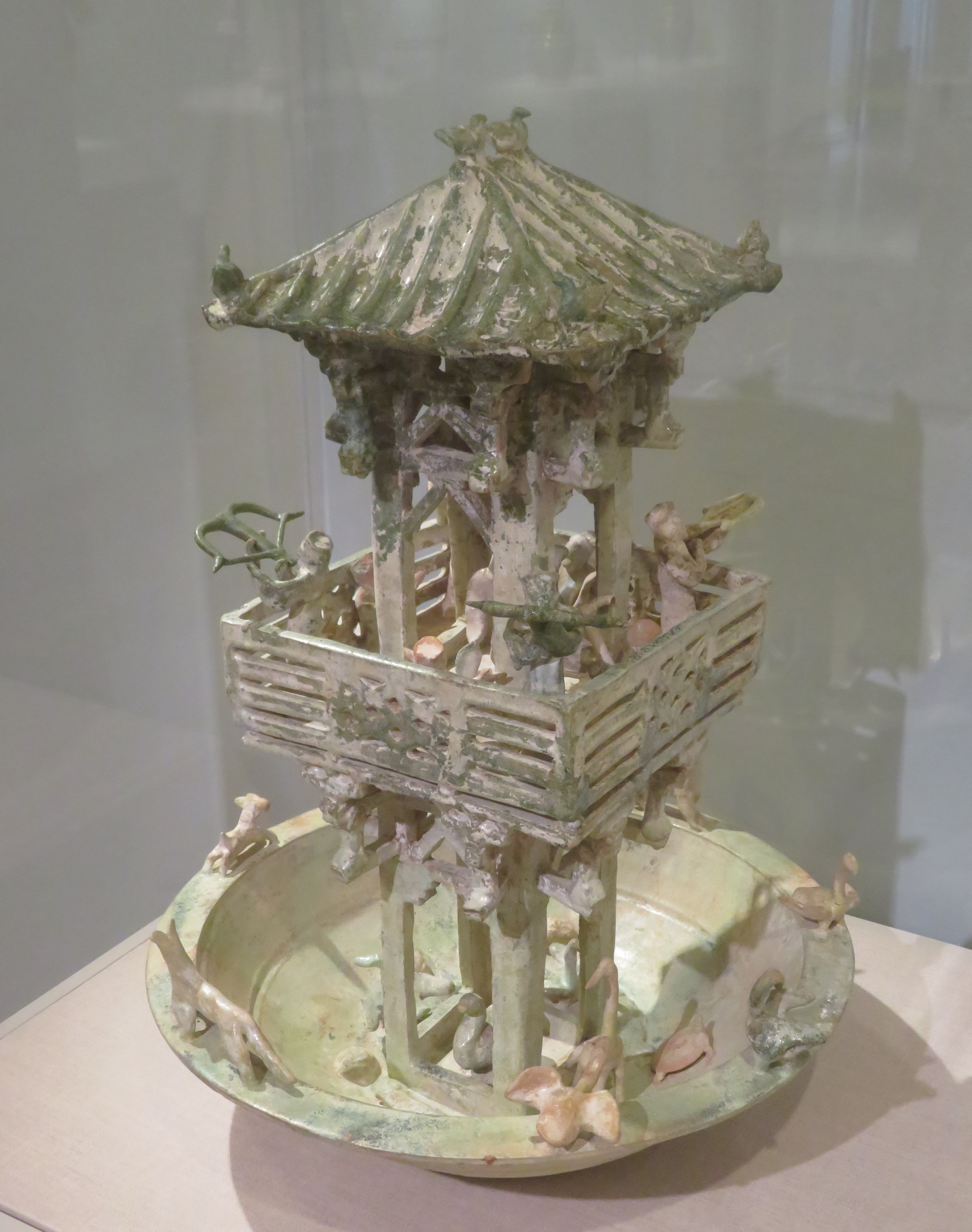
Tower Surrounded by a Moat, 1st-2nd century
Eastern Han Dynasty (25-220 CE)

What an exquisite piece for being nearly 2,000 years old!  The details and care it must have taken to fire it in a kiln.  More than a festive outing of an Emperor or Lord with his hunting party, this object is rife with hidden symbolism.  China 中国 (Zhong - Guo) is a combination of the symbols for "Middle" and "Land," the place the people of China have believe they hold within the larger scheme of the world. The structure represents a mountain that rises out of water. The humans reside on a platform; higher than the natural world below, but lower than the tile roof with it's doves representing the heavens. The archers stand ready at the four corners (East, West, North and South) to defend their lord.

One of the archers.

Dogs chase rabbits and geese around the rim of the bowl, while figures of swans, cranes and fish inhabit the now dry basin.


Sake Bottle, 19th century,
Possibly Niigata Prefecture, Japan

I was captivated by the whimsical image of the sailing ship and ocean waves.

Glass Bowl, 2004
Do Ho Suh, 1962 - (South Korean)

I think this was the most contemporary of the pieces in these galleries.  I don't know how well the image depicts the bottom of the bowl.  The rough area is the imprint of two human hands pressed together in the manner of the State Farm insurance logo.  


Dinner: Caramelized Onions, Mushrooms & Spinach over Linguine


Latest Appellate Judge Confirmed: The Honorable Arianna J. Freeman to the Third Circuit


Tuesday, October 4, 2022

Shakespeare Theatre Company: The Notebooks of Leonardo da Vinci


This is the second production that I have seen which comes to the DMV from the Goodman Theatre in Chicago.  The first was a production of "Moby Dick" hosted by Arena Stage.  It was transfixing.  A melding of actors with costumes with props with sets with sound with lighting.  It set a high bar for my expectations.  It even included some of the same actors.

What is the "Notebooks of Leonardo da Vinci"?  At its most basic it's just that.  The words of da Vinci taken verbatim out of his copious collection of notebooks and writings.  Not a single word from any other source.  It is loosely thematic and taps all of the major themes of his genius: Nature, Physics, Mechanics, Anatomy, and Art...and the creation of Art.  And even a snipe or two at Michelangelo and Botticelli for fun.  Wrapped in all of the other elements--it is also a transfixing experience.

In other words, the staging is in keeping with the previous Goodman offering.  Very physical, very integrated...a set that is as vertical as it is horizontal.  Eight actors (five men and three women) embody da Vinci's words bring them to life in an ever changing tapestry.  

So, yes, it was amazing theatre.  There is no need to highlight one actor over another.  All are fully and joyfully engaging.  The Notebooks of Leonardo da Vinci was icing on the cake of my extended theatre weekend. 

L-R: John Gregorio, Kasey Foster, Andrea San Miguel, Anthony Irons

L-R (up stage): Louise Lamson, Kasey Foster, Andrea San Miguel
L-R (down stage): Anthony Irons, Wai Yim, Adeoye, Christopher Donahue

L-R: Kasey Foster and John Gregorio

L-R: Wai Yim, Adeoye, Andrea San Miguel, Louise Lamson

L-R: Christopher Donahue and Kasey Foster

Sunday, October 2, 2022

1st Stage: Mlima's Tale

 This weekend illustrates two of the things that I love the best about Theater in the DMV.  On a single weekend you can go to one of the oldest and probably the most historically significant theater in the nation (Ford's Theater in DC) and see a classic American Play ("The Trip To Bountiful" by Horton Foote) on Saturday, and then on Sunday see an exciting new play (Milma's Tale) by one of our rising star playwrights (Lynn Nottage) at a relatively new, scrappy regional theatre troupe (1st Stage in Tysons, VA).  It's all the best that theatre has to offer.  

My only complaint is that 1st Stage is still refraining from printing playbills.  I'm sorry, it's the one souvenir that should be part of every trip to see a play or musical.

That notwithstanding, Mlima's Tale was powerfully and beautifully crafted.  Mlima (Mountain in Swahili) is one of the last old tusk elephants left in the wilds of Kenya.  The play begins with a beautiful long monologue of the live and generations of Mlima and his herd.  This if followed by his death at the hands of Somali poachers.  An intentionally wrenching scene after which Mlima becomes a ghost.  Unable to separate his spirit front his treasured massive tusks we are taken their journey from their smuggling away from Kenya to Vietnam and the finally China.  

Jeremy Keith Hunter portrays Mlima, majestic in life, tortured in death.  It is a tour de force performance from an actor I've enjoyed watching grow over the years.  Hunter is joined by a trio of actors: Andrew V. Ly, Diedra Lawan Starnes, and Shaquille Stewart.  Each plays 8 to 10 other characters of various ethnicities and genders with a range of accents that often mark their transitions with the clear efficiency of flipping a switch.  They function with an ease as an ensemble that was highlighted by an electrical problem that briefly brought the performance to a pause.  The performance was so good, that even this unwelcome incident did nothing to tarnish my enjoyment.  

One of the hallmarks of 1st Stage in my mind is the way in which the lighting and the sets are always so intertwined into a single component.  When you weave in the work of such a fine cast, you get the magic you always hope for.  I was the first, but not the last to rise to my feet in applause.

Jeremy Keith Hunter as Mlima in the opening monologue

Mlima's death throws

A local official who orchestrated Mlima's poaching (Shaquille Stewart) convincing his nephew (Andrew V. Ly) who is head of the security force charges with protecting Mlima

Andrew V. Ly and Jeremy Keith Hunter, Mlima expressing gratitude for the attempt to find the truth of his murder and reject corruption

The game reserve's director (Deidra Lawan Starnes) holding a press conference to answer questions regard the death of Mlima, a national icon in Kenya

Ly as a Vietnamese diplomat interested in smuggling Mlima's tusks out of Kenya

Starnes as the wife of wealthy Chinese businessman who purchases the tusks as a present for her husband and a show piece for their new penthouse apartment

The unveiling of carved tusks


Saturday, October 1, 2022

Dinner: Classic Beef Stew


Ford's Theatre: The Trip To Bountiful

Ford's Theatre's autumn production is Horton Foote's classic tale "The Trip To Bountiful." It's been done many times to great acclaim, and I have never seen it before. So I have nothing to compare this performance to. I loved it! The staging was about the best I've ever seen at Ford's with a set that transformed itself effortlessly from an over stuffed and overcrowded two-room apartment to bus depots then a bus seat on to the grassy flood plain of a lost town called Bountiful.

Likewise the sound, lighting, and costumes were wonderful. I have a special shout out to a member of the design core that rarely gets acknowledged unless their work fails. Kudos to Lynn Watson, the voice and dialect coach. The actors playing Carrie Watts and Jessie Mae Watts were spot on.

Early on in exploring this season in the DMV theatre, I had been excited to see this production for the first time, and then less so when I learned that a certain actor had the role of Ludie. The actor is a fine journeyman. He can memorize lines with exquisite precision, and he never misses a cue. The problem is he also never stops being himself completely. He's something of a staple around these parts and honestly many a fine production dips to minus when he has a leading part. And then I learned that he had been replaced. Check smile. I think it was for the best.

As is, the actors were a joy to watch. I've seen Kimberly Gilbert in many roles across the DMV, and I declare her performance as Jessie Mae Watts was her finest one yet. For example, from the previous paragraph; when I know an actor and then wonder if I do know them because I see little evidence of past performances in their present portrayal, I am in awe. Emily Kester in the role of the kindly young stranger Thelma was pitch perfect. Her reserved empathy that slowly becomes affection for Carrie Watts was a journey made believable thanks to her embrace of the character. Of course, that leads us to the lead: Nancy Robinette as Carrie Watts. A bird trapped in a cage not of her making, longing to return to the home of her youth and all the memories that have sustained her in her long absence would be a good metaphor for Robinette's performance. Frustrated and furtive through much of the journey, once home all those cares lift like a bird. A lovely performance in every respect.

I kept expecting the ending to take a dark turn, but it didn't. When I figured out that it was written in 1953, its unapologetic sentimentality made more sense. A wonderful way to have spent a chilly damp afternoon.

Jessie Mae Watts (Kimberly Gilbert), Carrie Watts (Nancy Robinette) and Ludie Watts (Joe Mallon)

Mother Watts with Jessie Mae in their cramped two-room apartment in Houston

Carrie Watts on the verge of her great escape

Carrie Watts with her ad hoc travelling companion, Thelma (Emily Kester)

Jessie Mae, Ludie and Carrie Watts, finally at Bountiful